


Public universities in France for global students remain an attractive option in 2026 because they combine internationally recognised degrees, strong research environments and comparatively affordable public higher education. Students can choose universities specialising in science, engineering, medicine, technology, business, economics, law, humanities and social sciences.
France also offers a growing number of programmes taught wholly or partly in English. Campus France currently lists more than 1,600 such programmes across French higher education, although English-taught options are considerably more common at master’s level than at bachelor’s level.
For students comparing universities in France for international students, the key factors are not rankings alone. Programme content, language of instruction, tuition policy, city, accommodation costs, scholarships and career goals should all influence the final decision.
Key Takeaways
-
- Sorbonne University and Université Paris-Saclay are currently among France’s highest-ranked public universities.
-
- France has strong public universities both inside and outside Paris.
-
- Public university fees depend significantly on nationality, degree level and university exemption policies.
-
- Many French-taught programmes expect approximately B2 French proficiency.
-
- English-taught options are especially common at master’s level.
-
- International students should verify the university’s individual fee and admission policy before applying.
-
- Rankings can help compare institutions, but course quality and career relevance should guide the final choice.
Why Choose Public Universities in France?
France’s public higher education system receives substantial state support. This allows many public institutions to charge considerably lower registration fees than private universities and business schools.
Another advantage is academic variety. Students can pursue programmes in areas such as computer science, artificial intelligence, engineering, mathematics, economics, management, law, medicine, life sciences, humanities and social sciences.
France is also becoming easier to consider for students who do not already speak fluent French. Campus France maintains a dedicated catalogue containing more than 1,600 programmes taught partly or completely in English.
However, students should not assume that every programme is available in English. The language of instruction must be checked for the specific degree before applying.
Top Public Universities in France for Global Students in 2026
The following universities combine strong academic reputations, research activity and international visibility. The ranking references below use the QS World University Rankings 2027, published in June 2026, which is the latest QS global ranking available at the time of writing.
| Public University | Latest QS World University Ranking | Location | Strong Areas to Explore |
|---|---|---|---|
| Sorbonne University | #73 | Paris | Science, Engineering, Medicine, Humanities |
| Université Paris-Saclay | #76 | Paris region | Science, Mathematics, Engineering, Technology |
| Université Paris 1 Panthéon-Sorbonne | =#246 | Paris | Economics, Law, Management, Humanities |
| Université Paris Cité | =#303 | Paris | Health, Science, Humanities, Social Sciences |
| Université Grenoble Alpes | #387 | Grenoble | Science, Technology, Engineering, Research |
| Aix-Marseille University | =#443 | Aix-en-Provence/Marseille | Science, Law, Economics, Humanities |
| University of Strasbourg | =#456 | Strasbourg | Science, Health, Humanities |
| University of Montpellier | #473 | Montpellier | Science, Health, Life Sciences |
| University of Bordeaux | =#485 | Bordeaux | Science, Health, Technology, Humanities |
Rankings are useful as one comparison tool, but they should not be treated as a universal measure of the best university for every subject.
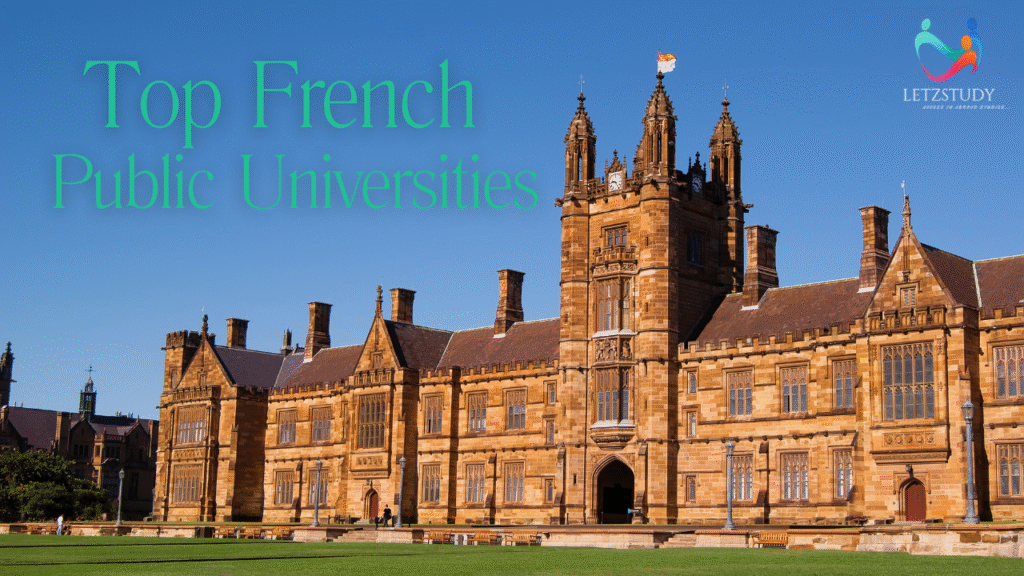
1. Sorbonne University
Sorbonne University is one of the best-known public research universities in France. It offers programmes across arts and humanities, science and engineering, medicine and related disciplines.
It is particularly relevant to international students interested in research-intensive subjects. Sorbonne also offers several master’s programmes entirely in English, including programmes in physics, computer science, molecular biosciences and computational mechanics. Undergraduate students should note that Sorbonne currently does not offer full bachelor’s degrees in English.
Another important 2026 update concerns fees. Sorbonne University approved an exemption policy for 2026–2027 under which eligible non-EU students covered by the policy pay the same registration fees as other students rather than the higher differentiated rate.
Best suited for: science, engineering, medicine, computer science and humanities.
2. Universite Paris-Saclay
Université Paris-Saclay is particularly strong for students interested in science, mathematics, engineering, computer science and research-oriented programmes.
Its academic network brings together university faculties, institutes, engineering schools and major research organisations. The university also has a substantial international postgraduate population.
For 2026–2027, Paris-Saclay states that non-EU students affected by differentiated tuition fees may receive a partial exemption that can reduce those fees to the level paid by domestic students, subject to its applicable conditions.
Best suited for: mathematics, physics, engineering, data science, computer science and research.
3. Universite Paris 1 Panthéon-Sorbonne
Paris 1 Panthéon-Sorbonne is particularly attractive to students interested in economics, management, law, political science, arts and humanities.
The university offers more than 300 programmes and has developed several English-taught options, particularly in economics and law. Examples include international economics tracks and selected postgraduate programmes.
Students should carefully check the language of instruction because many bachelor’s programmes remain French-taught.
Best suited for: law, economics, finance, management, political science and humanities.
4. Universite Paris Cite
Université Paris Cité offers a broad interdisciplinary environment with programmes spanning health sciences, science, humanities and social sciences.
It can be especially relevant for students seeking combinations of scientific research, health-related education and interdisciplinary study.
Some departments require around B2 French, while particular health-related courses may expect a higher level. Language requirements therefore need to be verified course by course.
The university has also maintained partial exemptions from differentiated tuition fees for certain non-EU students, making its individual tuition policy important to check before budgeting.
Best suited for: medicine and health-related sciences, life sciences, computer science, humanities and social sciences.
5. Universite Grenoble Alpes
Grenoble is one of France’s important science and technology centres, and Université Grenoble Alpes is a strong option for students interested in research, engineering and technology-related fields.
Its location can also appeal to students who want a major academic and innovation environment without living in central Paris.
The university is ranked #387 in the QS World University Rankings 2027.
Best suited for: science, technology, engineering, environmental studies and research.
6. Aix-Marseille University
Aix-Marseille University is one of France’s major comprehensive public universities. It has a large student community and offers programmes across science, health, economics, law, management, humanities and social sciences.
Its wide academic range makes it especially useful for students who want several disciplines available within one university system.
It is ranked =#443 in the QS World University Rankings 2027.
Best suited for: science, economics, law, humanities, health and interdisciplinary studies.
7. University of Strasbourg
The University of Strasbourg is a comprehensive public university with strengths across science, medicine, humanities and social sciences.
Its location near several European institutions and close to the German border also creates an international environment that can appeal to students interested in European affairs, languages and cross-border academic opportunities.
It is ranked =#456 in the QS World University Rankings 2027.
Best suited for: life sciences, medicine, chemistry, humanities and European studies.
8. University of Montpellier
The University of Montpellier has a long academic history and remains especially relevant for students considering science, medicine, health and life-science-related study.
Montpellier is also a major student city, which can make it attractive to students looking beyond Paris.
The university is ranked #473 in the QS World University Rankings 2027.
Best suited for: health sciences, medicine, biology, environmental science and research.
9. University of Bordeaux
The University of Bordeaux is a multidisciplinary public research university offering programmes across science, technology, health, social sciences and humanities.
It has a substantial international student community and may appeal to students looking for a large research university outside Paris.
The University of Bordeaux is ranked =#485 in the QS World University Rankings 2027.
Best suited for: science, health, technology, economics and multidisciplinary research.
Tuition Fees at Public Universities in France in 2026-27
Public university tuition in France requires careful explanation because the amount depends on nationality, degree level and university exemption policy.
Campus France lists the following national registration fees for the 2026–2027 academic year.
| Student Category | Bachelor’s | Master’s | Doctorate |
|---|---|---|---|
| EU/EEA/Swiss students | approximately €178/year | approximately €255/year | approximately €398/year |
| Non-EU students subject to differentiated fees | approximately €2,902/year | approximately €3,950/year | approximately €398/year |
These figures should not be interpreted as the fee every international student will automatically pay.
Some universities grant full or partial exemptions from differentiated fees. Sorbonne University and Université Paris-Saclay, for example, have university-specific exemption policies for 2026–2027.
Students should therefore check the exact programme and university fee policy before making financial plans.
Students in initial higher education may also need to pay the Contribution de vie étudiante et de campus (CVEC). For 2026–2027, it is approximately €105, unless the student qualifies for an exemption.
Eligibility for International Students
Admission criteria differ between universities and programmes, so there is no single academic score or language requirement for every public university in France.
Academic Requirements
For bachelor’s admission, students normally need a recognised secondary-school qualification that gives access to higher education.
For master’s admission, applicants generally need a relevant bachelor’s degree or equivalent qualification.
Competitive programmes may also consider:
-
- academic performance;
-
- prerequisite subjects;
-
- statement of motivation;
-
- previous projects or research;
-
- internships or professional experience;
-
- programme-specific entrance requirements.
French Language Requirements
Students applying to programmes taught in French should check the required CEFR level.
Campus France explains that B1 or B2 is commonly recommended for undergraduate and master’s studies, while B2 is required for first-year university admission through the DAP procedure. Some programmes may require C1 or C2.
Students who need to improve their French before studying can explore:
English Language Requirements
For programmes taught in English, universities may ask applicants to demonstrate English proficiency through IELTS, TOEFL or another accepted qualification.
There is no universal IELTS or TOEFL score for all French universities. Requirements depend on the particular course.
Students should therefore check the admissions page of the exact programme rather than relying on a general France-wide score.
How to Apply to Public Universities in France
The application route depends on your nationality, country of residence, qualification and study level.
For students living in countries covered by the Études en France procedure, Campus France operates the main digital application system. India is among the countries included in this process. Campus France currently lists 73 participating countries and territories.
A practical application process is:
-
- Shortlist your programme and university. Check curriculum, language, tuition fees and admission requirements.
-
- Confirm the application platform. Depending on your profile, this could involve Études en France, Parcoursup, DAP, a university application portal or another designated system.
-
- Prepare the required documents. Requirements vary by university.
-
- Submit before the programme deadline. Do not assume all French universities follow the same deadline.
-
- Respond to the admission offer and complete university enrolment requirements.
-
- Apply for the appropriate student visa when required.
- Apply for the appropriate student visa when required.
Students should begin researching well before the planned intake because French application calendars vary considerably between programme types.

Documents Commonly Required
Depending on the degree and institution, applicants may need:
-
- passport;
-
- academic transcripts;
-
- degree or school-leaving certificates;
-
- CV;
-
- statement of purpose or motivation letter;
-
- language proficiency certificate;
-
- recommendation letters where requested;
-
- programme-specific supporting documents;
-
- certified translations where required.
- certified translations where required.
Always follow the document checklist issued by the university or relevant application platform.
Scholarships for International Students in France
International students can explore French government scholarships, European programmes and university-specific funding.
France Excellence Eiffel Scholarship
The France Excellence Eiffel programme supports selected international students at master’s and doctoral levels.
Students do not normally submit an Eiffel application directly. A participating French higher education institution selects and submits candidates.
The programme provides a living allowance and certain services such as transport and insurance. Scholarship recipients pursuing eligible national degrees at qualifying public institutions may also benefit from tuition exemptions under applicable rules.
Erasmus Mundus Scholarships
Students considering selected international joint master’s programmes can explore Erasmus Mundus Joint Masters.
Competitive Erasmus Mundus scholarships can contribute towards programme participation, travel, visa and living expenses.
University and Institutional Scholarships
Individual universities may offer:
-
- merit-based scholarships;
-
- mobility grants;
-
- tuition exemptions;
-
- research funding;
-
- programme-specific scholarships.
- programme-specific scholarships.
Funding conditions vary widely, so students should check the scholarship page of each shortlisted institution.
Cost of Living for Students in France
Living costs vary considerably according to city, accommodation type and lifestyle.
Paris is normally more expensive than most regional French cities. Campus France advises students to prepare carefully for accommodation, food, transportation and other everyday expenses and notes that large cities can have costs close to those of Paris.
As a planning reference, some Campus France guidance estimates a student budget of roughly €1,350 per month in Paris and around €940 per month elsewhere in France, although actual spending can be lower or higher.
Accommodation usually represents the largest expense.
Students comparing universities should therefore compare the total study budget, not tuition fees alone.
A university with slightly different fees in Grenoble, Montpellier, Strasbourg or Bordeaux may result in a very different total budget from studying and renting accommodation in central Paris.
Student Visa and Financial Requirements
Admission to a French university and approval of a French student visa are separate processes.
Non-EU students who require a long-stay student visa must meet the applicable France-Visas requirements.
One important 2026 change is the financial-resource requirement. France-Visas states that student long-stay visa applications submitted from 1 August 2026 must include proof of resources of at least €877.50 per month.
Visa requirements can change, so applicants should always verify the latest checklist before submitting an application.
Receiving university admission does not guarantee visa approval. Visa decisions depend on whether the applicant satisfies the applicable immigration requirements.
Can International Students Work While Studying in France?
Eligible international students holding a qualifying student residence permit or VLS-TS student visa can generally work up to 964 hours per year, equivalent to approximately 60% of the standard annual working duration.
Working beyond this limit may require additional authorisation depending on the circumstances.
Part-time work can provide useful experience and supplementary income, but students should not rely on employment alone to finance their complete study and living costs.
How to Choose the Right Public University in France
The highest-ranked university is not automatically the best university for every student.
Compare the following before making a decision:
-
- Course curriculum: Check whether the modules match your academic and career interests.
-
- Language of instruction: Confirm whether the entire programme is in French, English or a combination.
-
- Tuition policy: Check whether differentiated non-EU fees or exemptions apply.
-
- Location: Compare Paris with regional cities based on lifestyle and budget.
-
- Specialisation: A university with a lower overall ranking may be excellent in your chosen subject.
-
- Career and research opportunities: Look at laboratories, industry partnerships, internships and further-study options.
-
- Admission fit: Apply to universities that realistically match your academic background and prerequisites.
- Admission fit: Apply to universities that realistically match your academic background and prerequisites.
A good shortlist should therefore balance reputation, affordability, programme quality and personal career goals.
FREQUENTLY ASKED QUESTIONS
Are public universities in France free for international students?
Not generally. French public universities charge registration fees, but these can be considerably lower than fees at many private institutions. Non-EU students may face differentiated tuition fees, although exemptions can apply depending on the university and individual situation.
Which public university in France is best for international students?
There is no single best university for every student. Sorbonne University and Université Paris-Saclay are among the country’s highest-ranked public universities, while Paris 1 Panthéon-Sorbonne is especially relevant for economics, law and humanities. Grenoble, Strasbourg, Montpellier, Bordeaux and Aix-Marseille also offer strong options depending on the subject.
Can I study in France without knowing French?
Yes, if you choose a programme taught in English and meet its admission requirements. Campus France lists more than 1,600 programmes taught completely or partly in English. However, English-taught opportunities are much more extensive at postgraduate level.
Learning basic French is still useful for daily life, internships and integration.
Is IELTS compulsory for public universities in France?
Not for every programme. English-taught programmes may request IELTS, TOEFL or another form of English-language evidence, while French-taught programmes generally focus on French proficiency. Each university sets its own requirements.
How much does it cost to study at a public university in France?
For 2026–2027, national public university registration fees are approximately €178 for a bachelor’s and €255 for a master’s for EU/EEA/Swiss students. Non-EU students subject to differentiated tuition fees may pay approximately €2,902 for a bachelor’s and €3,950 for a master’s. University exemptions can substantially change the actual amount.
Can international students work in France while studying?
Eligible international students holding the appropriate student immigration status can generally work up to 964 hours per year.
Inference
Public universities in France for global students offer a strong combination of academic quality, research opportunities, international recognition and comparatively affordable public education.
Sorbonne University and Université Paris-Saclay stand out for their global rankings, while Paris 1 Panthéon-Sorbonne, Paris Cité, Grenoble Alpes, Aix-Marseille, Strasbourg, Montpellier and Bordeaux provide excellent options across different disciplines and cities.
Before applying, compare the programme itself rather than relying only on university rankings. Check the language of instruction, 2026–2027 tuition policy, admission requirements, scholarships, living costs and application route. A well-matched university is more valuable than choosing an institution simply because it appears higher on a general ranking.
This article is for educational and informational purposes. University admission requirements, tuition fees, visa rules, scholarships, immigration policies and post-study opportunities may change. Students should verify the latest information with the relevant university, government authority, immigration department, embassy or official source before making a decision.
START YOUR STUDY ABROAD JOURNEY
If you are planning to study abroad and need help understanding your options, you can connect with a LetzStudy counsellor for personalised guidance. We can help you explore suitable countries, universities, courses, eligibility requirements, application steps and other aspects of your study-abroad journey based on your academic profile and goals.
