

An MBA in Europe for Indian students can be a strong option in 2026, especially for professionals seeking international business exposure, shorter programme formats and access to employers across major European markets.
Europe is home to internationally recognised business schools such as INSEAD, London Business School, HEC Paris and IESE Business School. Depending on the institution, a full-time MBA may take roughly 10 months to 21 months, which can reduce the time spent away from employment compared with some traditional two-year MBA formats.
However, choosing Europe should involve more than looking at rankings. Indian applicants need to compare tuition fees, work experience expectations, employment markets, language requirements, visa rules and their own career objectives.
This guide explains the main factors to consider before deciding whether an MBA in Europe is the right investment for you in 2026.
Why an MBA in Europe Appeals to Indian Students in 2026
European MBA programmes attract experienced professionals because many combine intensive management education with international classrooms, industry connections and relatively compact study durations.
Important advantages include:
-
- Shorter MBA formats: Some programmes can be completed in around 10 to 16 months.
-
- International classrooms: European business schools often enrol students from many countries and professional backgrounds.
-
- Access to multiple industries: Consulting, finance, technology, luxury, manufacturing, healthcare and entrepreneurship are major career areas across European markets.
-
- Cross-border exposure: Students may participate in international exchanges, projects and modules.
-
- English-taught programmes: Many leading European MBAs are delivered primarily or entirely in English.
-
- Different post-study pathways: Countries including Germany, France, Spain, the Netherlands and the UK provide qualifying graduates with routes to remain after study, although the conditions differ significantly.
Europe is particularly worth considering if you already have professional experience and want your MBA to support a career transition, international mobility or progression into management.
Best Countries in Europe for Indian MBA Students
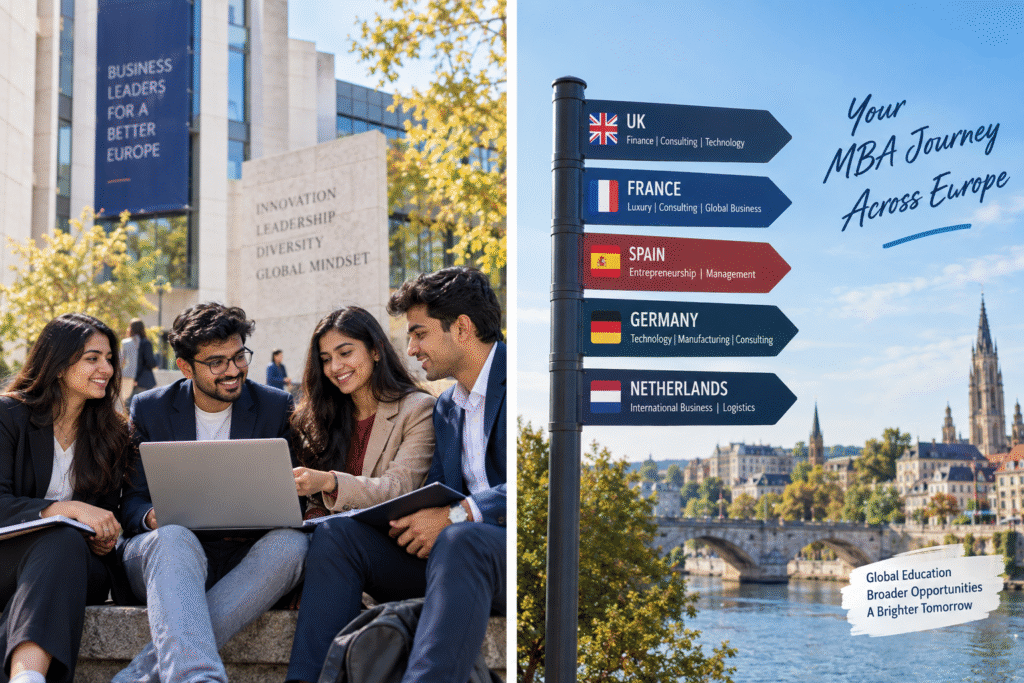
There is no single best European country for every MBA applicant. Your choice should depend on your target industry, preferred employers, budget, language ability and post-study plans.
| Country | Suitable for students interested in | Examples of business schools |
|---|---|---|
| United Kingdom | Finance, consulting, technology, entrepreneurship | London Business School, Oxford Saïd, Cambridge Judge |
| France | Consulting, luxury, finance, technology, global management | INSEAD, HEC Paris |
| Spain | Consulting, general management, entrepreneurship, technology | IESE, IE Business School, ESADE |
| Germany | Technology, manufacturing, consulting, industrial management | Mannheim Business School, ESMT Berlin |
| Netherlands | Consulting, technology, logistics and international business | Rotterdam School of Management |
United Kingdom
The UK remains attractive for students targeting London-based consulting, finance, technology and international corporate roles.
London Business School offers a flexible MBA with exit points at approximately 15, 18 or 21 months. Its published tuition for the 2026 intake is approximately £123,950, excluding additional programme-related expenses.
Students considering the UK should pay particular attention to the revised Graduate visa rules. Applicants to the Graduate route on or after 1 January 2027 receive 18 months of permission rather than two years for eligible non-doctoral qualifications.
France
France is home to INSEAD and HEC Paris and can be particularly attractive for consulting, luxury, finance, technology and multinational business careers.
INSEAD’s MBA can be completed in approximately 10 months, while HEC Paris provides approximately 12-month and 16-month formats.
Eligible non-European graduates who complete a qualifying master’s-level programme in France may be able to apply for the country’s job-search or business-creation residence route for approximately one year, subject to the applicable conditions.
Spain
Spain has several internationally recognised business schools, particularly in Barcelona and Madrid.
IESE offers approximately 15-month and 19-month MBA pathways, allowing students to choose between a faster route and a longer format that can provide additional opportunities for electives, projects or internships.
Spain also provides qualifying higher-education graduates with a residence authorisation for job searching or starting a business for up to 24 months. An important limitation is that this particular job-search authorisation does not itself permit employment, so graduates who find an appropriate job need to move to the relevant employment authorisation.
Germany
Germany can appeal to MBA candidates targeting manufacturing, automotive, technology, engineering-led companies, consulting and international business.
One major advantage for students completing an eligible German higher-education qualification is the possibility of obtaining a residence permit for up to 18 months to find qualified employment. During this period, graduates are permitted to work while searching for skilled employment.
German-language ability may also improve access to employers even when the MBA itself is taught in English.
Netherlands
The Netherlands attracts international professionals in technology, consulting, logistics, financial services and multinational corporations.
Qualifying graduates can apply for an orientation-year residence permit. The Dutch government states that eligible graduates can apply within three years of graduation and are free to work during the orientation year.
For candidates prioritising international workplaces and access to continental Europe, the Netherlands can therefore be worth evaluating.
Leading MBA Colleges in Europe for 2026
The table below shows examples of well-known European MBA programmes and their currently published fee structures. Fees should always be treated as approximate because schools can revise them by intake.
| Business School | Location | Approximate Programme Length | Approximate Published Tuition |
|---|---|---|---|
| INSEAD | France / Singapore | Around 10 months | Approximately €109,860 |
| London Business School | UK | Around 15–21 months | Approximately £123,950 |
| HEC Paris | France | Around 12–16 months | Approximately €102,000 |
| IESE Business School | Spain | Around 15 or 19 months | Approximately €117,000 |
INSEAD lists tuition of approximately €109,860 for its August 2026 and January 2027 intakes. London Business School lists approximately £123,950 for its 2026 MBA intake. HEC Paris currently lists its MBA at approximately €102,000, while IESE lists approximately €117,000 for its upcoming full-time MBA intake.
These figures demonstrate why business-school selection should be based on expected career value rather than prestige alone. Compare curriculum, recruiters, alumni presence in your target market, programme duration and total financial commitment.
MBA in Europe Eligibility for Indian Students
MBA eligibility differs by institution, but competitive European business schools generally evaluate academic capability, professional achievements, leadership potential and career direction.
Academic Background
Most applicants hold a recognised bachelor’s degree or equivalent qualification.
Individual schools may have different policies. For example, INSEAD states that candidates without an undergraduate degree can still be considered in exceptional circumstances when they have a strong professional record and appropriate test performance.
Always check the requirement of the individual programme rather than assuming that every European MBA follows the same rule.
Work Experience
Professional experience is one of the biggest differences between an MBA and many pre-experience master’s programmes.
INSEAD reports approximately six years of average work experience, with participants commonly falling within a range of roughly two to ten years. London Business School describes its main MBA as designed primarily for candidates with around five or more years of professional experience. IESE similarly indicates prior professional experience of roughly five years for its full-time MBA.
Quality matters as much as duration. Promotions, leadership responsibility, measurable impact and career progression can strengthen an application.
GMAT or GRE
GMAT and GRE policies vary.
Some leading programmes require one of these tests, while other institutions may provide waivers, accept alternative assessments or evaluate applicants differently.
INSEAD, for example, requires a GMAT or GRE for its MBA and does not currently offer a general test waiver. It accepts either test without indicating a preference between them.
Indian applicants should therefore check each shortlisted programme before deciding whether they need to prepare for the GMAT or GRE.
English-Language Requirements
MBA programmes taught in English may require proof of English proficiency through tests such as IELTS, TOEFL or another accepted examination.
Exemptions may be available when previous education was conducted entirely in English, but policies differ between institutions.
Do not assume that studying previously in India automatically provides an exemption. Check the exact language policy of each school.
Application Profile
A competitive MBA application commonly includes:
-
- academic transcripts;
-
- CV or résumé;
-
- GMAT or GRE results where required;
-
- English-language test result where required;
-
- essays or motivation statements;
-
- recommendation letters;
-
- professional employment information;
-
- application fee;
-
- interview or video assessment.
Admissions committees also look at how clearly the MBA connects with your previous experience and future career plan.
MBA Fees in Europe and Budget Planning
Tuition Fees
The cost of an MBA in Europe varies significantly.
At globally recognised private business schools, tuition can exceed approximately €100,000 or £100,000. Other universities and MBA providers may have lower tuition levels.
Instead of comparing tuition alone, calculate the full financial commitment:
Total MBA budget = tuition + accommodation + food + insurance + transport + visa-related costs + travel + programme expenses + opportunity cost
A shorter MBA may have high tuition but reduce the number of months spent outside the workforce. A longer MBA may provide more time for internships, networking and career switching.
Neither format is automatically better.
Living and Additional Expenses
Living costs depend heavily on location and lifestyle.
London, Paris, Barcelona, Berlin, Rotterdam and smaller university towns can have very different housing markets. Students should budget for:
-
- accommodation;
-
- utilities;
-
- food;
-
- local transport;
-
- health insurance;
-
- study materials;
-
- visa and residence costs;
-
- flights between India and Europe;
-
- deposits for accommodation;
-
- international study trips;
-
- personal expenses.
For example, INSEAD’s current planning estimates for a single participant in Fontainebleau include approximately €11,000 for accommodation, approximately €6,000 for meals and additional amounts for transportation and other expenses across its approximately ten-month programme. Actual spending varies considerably.
Always maintain a financial buffer rather than planning only around minimum estimates.
Scholarships and Financing Options for Indian Students
Funding an MBA usually involves a combination of personal savings, scholarships, loans and sometimes employer sponsorship.
Potential financing routes include:
-
- merit-based business-school scholarships;
-
- need-based assistance;
-
- diversity and leadership scholarships;
-
- external education scholarships;
-
- Indian education loans;
-
- international student loans;
-
- employer sponsorship;
-
- personal or family savings.
Some schools automatically assess admitted students for selected awards, while others require separate scholarship applications.
HEC Paris, for example, offers multiple MBA scholarships and states that its scholarship deadlines generally run alongside MBA application deadlines.
Applying early can therefore matter. Do not wait until after receiving an admission offer to begin researching funding.
How to Apply for an MBA in Europe from India
A practical application process looks like this:
-
- Define your post-MBA goal. Decide whether you want consulting, finance, technology, entrepreneurship, product management or another field.
-
- Choose target countries. Consider employment prospects, language, tuition, living costs and immigration rules.
-
- Shortlist MBA programmes. Compare curriculum, class profile, recruiters, programme length and alumni network.
-
- Check eligibility requirements. Confirm work experience, academic requirements and test policies.
-
- Prepare for the GMAT or GRE if required. Allow enough time for preparation and possible retakes.
-
- Complete English-language testing where necessary.
-
- Prepare your CV, essays and recommendations. Show career progression, achievements, leadership and clear MBA objectives.
-
- Submit applications early. Earlier rounds can give applicants more time for funding and visa preparation.
-
- Prepare for interviews. Be ready to explain why you need an MBA, why that school fits your plans and what you will contribute to the class.
-
- Plan funding and immigration documentation after admission. Admission does not guarantee a student visa or residence permission. You must separately satisfy the immigration requirements of your chosen country.
Career Opportunities After an MBA in Europe
Popular Post-MBA Career Paths
European MBA graduates commonly target areas such as:
-
- management consulting;
-
- investment banking and financial services;
-
- strategy;
-
- product management;
-
- technology;
-
- operations and supply chain;
-
- luxury and consumer goods;
-
- healthcare;
-
- sustainability;
-
- entrepreneurship;
-
- corporate leadership programmes.
The right market depends on your previous experience.
For example, a software professional moving into technology product management may evaluate different schools from someone targeting investment banking or luxury brand management.
Language ability can also influence career options. While many international companies operate in English, local-language skills may significantly expand the number of employers available in some European markets.
Post-Study Options in Major European Destinations
Post-study residence arrangements are an important consideration, but they should never be treated as guaranteed employment routes.
| Country | Current post-study pathway for qualifying graduates |
|---|---|
| UK | Graduate route is generally 18 months for eligible non-doctoral applications made from 1 January 2027 |
| Germany | Up to 18 months to search for qualified employment after eligible German studies |
| France | Approximately 1 year under the eligible job-search/business-creation route |
| Spain | Up to 24 months for eligible job search or business creation, but the permit itself does not authorise employment |
| Netherlands | Approximately 1-year orientation period for qualifying graduates |
These rules can carry additional eligibility conditions and may change.
One particularly important point for students beginning a UK MBA in 2026 is timing. A student graduating and applying for the UK Graduate route after 1 January 2027 would generally fall under the newer 18-month period rather than the previous two-year period.
Is an MBA in Europe Worth It for Indian Students?
An MBA in Europe can be worth considering when your career goals justify the investment.
It may be a strong fit if you:
-
- already have meaningful professional experience;
-
- want an international career;
-
- intend to switch industry or function;
-
- are targeting employers that actively recruit from your chosen business school;
-
- value an international alumni network;
-
- can finance the programme without taking unsustainable financial risk;
-
- have researched the local employment market.
You should reconsider or delay the MBA if you are choosing it only because the school is highly ranked or because you assume studying abroad automatically leads to a high-paying job.
Calculate potential return on investment using your own situation:
Expected career improvement + network + international exposure + long-term opportunities
versus
Tuition + living expenses + loan interest + lost salary + immigration and employment uncertainty
That comparison provides a far better answer than rankings alone.
Common Mistakes to Avoid
Indian MBA applicants should avoid:
-
- choosing a school only by global ranking;
-
- ignoring employment outcomes in their target industry;
-
- assuming every European country offers the same post-study rights;
-
- applying without a clear career story;
-
- underestimating living and relocation costs;
-
- relying entirely on scholarships;
-
- applying too late for competitive admissions rounds;
-
- ignoring local-language requirements in the job market;
-
- confusing university admission with visa approval;
-
- taking a very large education loan without evaluating realistic career outcomes.
A successful MBA decision begins before the application itself.
Key Takeaways
-
- An MBA in Europe for Indian students can provide international exposure, shorter programme formats and access to several major business markets.
-
- Leading European MBAs range from approximately 10 months to 21 months depending on the programme.
-
- Top-school tuition can exceed approximately €100,000 or £100,000, so total return on investment matters.
-
- Work experience, career progression and leadership potential are important parts of MBA admission.
-
- GMAT and GRE policies differ by school.
-
- Post-study rules vary significantly between European countries and should be checked before choosing a destination.
-
- Select an MBA according to your career goal, target employers, finances and preferred country rather than ranking alone.
Frequently Asked Questions
Is Europe good for an MBA for Indian students?
Yes, Europe can be a strong MBA destination for Indian professionals seeking international exposure, globally recognised business schools and access to industries such as consulting, finance, technology, manufacturing and luxury. The right choice depends on the student’s career goals and finances.
How much does an MBA in Europe cost?
Costs vary significantly. Some leading European business schools currently charge approximately €100,000 or more, while London Business School lists tuition of approximately £123,950 for its 2026 MBA. Other European universities may offer lower-cost programmes. Living and additional expenses must be calculated separately.
Can Indian students pursue an MBA in Europe without GMAT?
Some European MBA programmes may offer alternatives or waivers, but this varies by institution. Others still require GMAT or GRE results. INSEAD, for example, currently requires a GMAT or GRE for MBA applicants.
How much work experience is required for an MBA in Europe?
There is no universal requirement. Competitive full-time European MBAs often enrol applicants with several years of professional experience. INSEAD reports approximately six years on average, while LBS and IESE primarily target experienced professionals.
Which European country is best for an MBA?
It depends on your career target. The UK may suit finance and consulting candidates, France has strong options for consulting and luxury, Spain has major international business schools, Germany can suit technology and industrial careers, while the Netherlands provides access to international companies.
Can Indian students work in Europe after completing an MBA?
Potentially, yes, if they satisfy the relevant immigration and employment requirements. Germany, France, Spain, the Netherlands and the UK all provide different post-study pathways for qualifying graduates, but duration and work permissions differ. A post-study residence route does not guarantee employment.
Inference
An MBA in Europe for Indian students in 2026 can be a smart choice when the programme supports a clearly defined career goal.
Europe offers respected business schools, international networks, different programme lengths and access to major global industries. At the same time, high tuition fees, living expenses, competitive recruitment and changing immigration rules mean students need to choose carefully.
Compare business schools based on career outcomes, curriculum, recruiters, programme duration, total cost and post-study conditions. The right MBA is not simply the highest-ranked option. It is the programme that provides the strongest fit between your experience, finances and long-term career plan.
This article is for educational and informational purposes. University admission requirements, tuition fees, visa rules, scholarships, immigration policies and post-study opportunities may change. Students should verify the latest information with the relevant university, government authority, immigration department, embassy or official source before making a decision.
Start Your Study Abroad Journey
If you are planning to study abroad and need help understanding your options, you can connect with a LetzStudy counsellor for personalised guidance. We can help you explore suitable countries, universities, courses, eligibility requirements, application steps and other aspects of your study-abroad journey based on your academic profile and goals.
Book a Free Consultation.
