
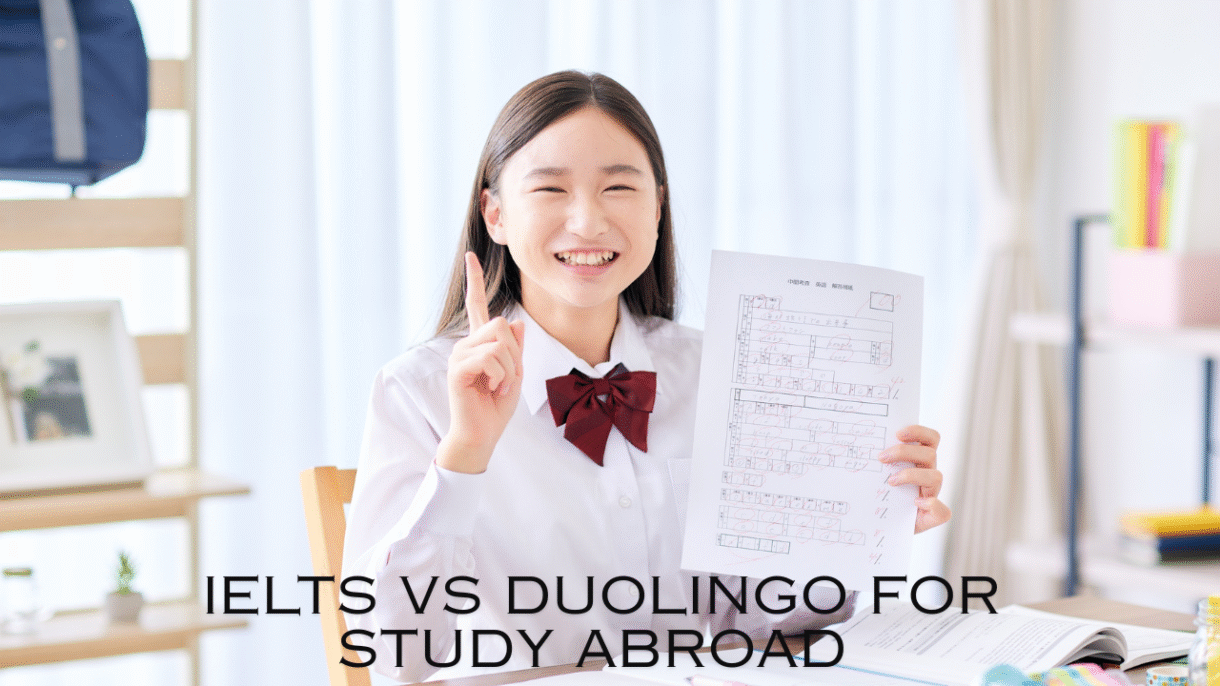
Choosing the right English proficiency test can affect your study-abroad application, especially when universities accept multiple options. IELTS and the Duolingo English Test (DET) are two widely considered choices for international students, but they differ in format, testing experience, scoring and acceptance.
IELTS Academic assesses Listening, Reading, Writing and Speaking through a structured test that takes about 2 hours and 45 minutes. The Duolingo English Test is an online adaptive assessment that can be taken remotely and is designed to measure English proficiency through integrated skills.
Neither test is automatically better for every student. The more suitable choice depends on your target university, programme, country, application timeline, budget and whether the specific institution accepts the test you plan to take.
IELTS vs Duolingo: What Is the Difference?
The main difference is how the two tests are delivered and used.
IELTS Academic is an established English proficiency examination used by thousands of educational institutions, employers, professional bodies and governments worldwide. It evaluates four skills: Listening, Reading, Writing and Speaking.
Duolingo English Test (DET) is an online English proficiency test designed for remote testing. Its acceptance has expanded significantly, with Duolingo reporting more than 6,500 programmes accepting the test as of 2026. However, acceptance can vary by university, programme and level of study.
In simple terms:
- IELTS: broader and more established acceptance across education and other contexts.
- Duolingo: convenient online testing with growing university acceptance.
- IELTS: includes a separate Speaking component with an examiner.
- Duolingo: completed online through an adaptive test experience.
- IELTS: uses a 1–9 band scale.
- Duolingo: reports scores on a 10–160 scale.
The most important consideration is not simply which test seems easier. Check whether your chosen university and programme accept the test and what minimum score they require.
IELTS Academic and Duolingo English Test at a Glance
| Feature | IELTS Academic | Duolingo English Test |
|---|---|---|
| Main purpose | Academic English proficiency | English proficiency for admissions and other approved uses |
| Skills assessed | Listening, Reading, Writing, Speaking | Reading, Writing, Listening, Speaking through integrated tasks |
| Delivery | Computer-based; selected markets may offer Writing on Paper | Online |
| Test location | Test centre or eligible online option, depending on market | At home |
| IELTS score scale | 0–9 bands | 10–160 |
| Speaking | Live speaking assessment | Integrated speaking tasks |
| Test duration | About 2 hours 45 minutes | About 1 hour |
| Score validity | Generally 2 years | 2 years |
| Acceptance | Thousands of institutions worldwide | 6,500+ programmes reported by Duolingo in 2026 |
| Best-known advantage | Broad recognition and established format | Convenience and remote testing |
For either test, always check the latest requirements of your university before booking an exam.
How Do IELTS and Duolingo Compare by Test Format?
IELTS Academic Test Format
IELTS Academic consists of four sections:
- Listening
- Reading
- Writing
- Speaking
The overall test time is approximately 2 hours and 45 minutes. Listening takes about 30 minutes, Reading 60 minutes, Writing 60 minutes and Speaking 11–14 minutes.
The IELTS Writing section contains two tasks. Task 1 requires at least 150 words, while Task 2 requires at least 250 words. Task 2 carries greater weight in the Writing score.
The Speaking section is conducted as a structured interaction with an examiner. It lasts around 11–14 minutes and contains three parts.
This format may suit students who are comfortable with a traditional examination structure and prefer demonstrating speaking ability directly to an examiner.
Duolingo English Test Format
The Duolingo English Test is designed to be completed online rather than at a conventional test centre.
The assessment uses adaptive testing, meaning the difficulty of certain questions can adjust according to the test taker’s performance. The test evaluates English through reading, writing, listening and speaking, with subscores including Literacy, Comprehension, Conversation and Production.
The remote format can be particularly convenient for students who do not want to travel to a test centre.
However, online testing also means that students need to carefully follow the test environment and technical requirements. A suitable computer, internet connection and appropriate testing environment are important.
IELTS vs Duolingo Scoring System
IELTS reports results using a band scale from 0 to 9, with whole and half bands commonly reported. The four skills receive individual scores, which contribute to the overall band score.
The Duolingo English Test reports an overall score from 10 to 160 and provides subscores covering different combinations of English skills.
Because the scoring systems are different, students should not assume that one numerical score directly equals another.
For example, an IELTS requirement of 6.5 should not be interpreted by simply choosing a DET score based on a generic conversion chart. The university’s own published score requirement should take priority.
Some universities may specify a minimum overall score as well as minimum section or subscore requirements. Therefore, read the full English-language requirement rather than looking only at the headline score.

IELTS vs Duolingo: Cost, Duration and Results
Cost and convenience are important factors for students, particularly when applying to several universities.
| Factor | IELTS Academic | Duolingo English Test |
|---|---|---|
| Testing method | Computer-based; availability varies by market | Online from home |
| Approximate duration | 2 hours 45 minutes | Around 1 hour |
| Score scale | 0–9 bands | 10–160 |
| Score validity | Generally 2 years | 2 years |
| Results | Depends on test format and delivery | Standard results generally available within 48 hours |
| Speaking | Separate speaking assessment | Integrated within online assessment |
| Test-centre visit | May be required depending on test option | Not required |
The exact IELTS fee varies by country and test location, so Indian students should check the current fee displayed by the official IELTS provider when booking.
For the DET, current 2026 information lists the standard price at US$70 for one test, although the amount paid in Indian rupees can vary because of exchange rates and applicable taxes.
Duolingo also states that DET results are valid for two years.
Rather than choosing purely on price, compare the cost with your application requirements. Taking a cheaper test that is not accepted by your chosen programme could create additional costs and delays.
Which Universities Accept IELTS and Duolingo?
IELTS has extensive international recognition. Its official organisation directory includes thousands of educational institutions, employers, governments and professional organisations that accept IELTS.
The Duolingo English Test has also expanded significantly. Duolingo reported in 2026 that more than 6,500 programmes accepted the DET. Acceptance can nevertheless differ between programmes at the same university.
This distinction is extremely important.
A university may accept Duolingo for:
- Undergraduate admission
- Certain Master’s programmes
- Selected postgraduate programmes
- Specific faculties or departments
However, another programme at the same institution may have different requirements.
Before booking either test:
- Visit the official university website.
- Find the English-language requirements for your exact programme.
- Check whether IELTS or DET is listed.
- Note the minimum overall score.
- Check whether individual section or subscore requirements apply.
- Check whether there are additional requirements for scholarships, professional registration or immigration purposes.
Do not rely only on a third-party list of universities accepting Duolingo.
IELTS vs Duolingo for Different Study Abroad Plans
The better option can change depending on your circumstances.
If You Are Applying to Many Universities
IELTS may be the more straightforward choice when you are applying to a wide range of institutions and want a test with broad established recognition.
This is particularly useful when your shortlist includes universities with different English-test policies.
If You Prefer Taking the Test From Home
The Duolingo English Test may be attractive if your target programmes accept it and you prefer online testing.
You can take the DET remotely rather than travelling to a conventional test centre.
If You Need a Widely Recognised Test
IELTS has long-standing recognition among universities, governments, employers and professional organisations.
That broad recognition can make IELTS a practical option when your future plans extend beyond a single university application.
If You Want Faster Results
The DET can be convenient for students working with short application timelines because standard results are generally available within 48 hours.
Nevertheless, students should not leave testing until the last moment. Technical issues, retesting and university application deadlines can affect your timeline.
If Your Programme Has Specific English Requirements
In this situation, the university’s policy should determine your choice.
For example, if a programme lists IELTS Academic but does not list DET, taking the Duolingo test simply because it is shorter or cheaper may not help your application.
IELTS or Duolingo: Which Test Should You Choose?
Use the following decision guide:
| Your situation | Option to consider |
|---|---|
| Your university accepts both tests | Compare format, cost, timeline and your strengths |
| Your university accepts only IELTS | IELTS |
| Your university accepts only DET | Duolingo |
| You prefer a live speaking assessment | IELTS |
| You prefer an online home-based test | Duolingo |
| You are applying to institutions with different test policies | IELTS may offer broader flexibility |
| You need a quick testing option | DET may be convenient if accepted |
| You may need English proof for purposes beyond university admission | Check the specific organisation’s requirements before choosing |
There is no universal winner.
IELTS may be the safer choice when maximum recognition and flexibility are your priorities. DET may be the better fit when your universities accept it and you value convenience, remote testing and faster results.
Common Mistakes to Avoid When Choosing an English Test
Students sometimes select an English test based on price or social-media recommendations without checking the requirements of their actual university.
Avoid these mistakes:
- Assuming every university accepts Duolingo
- Assuming IELTS is always required
- Checking university-level acceptance but ignoring programme-specific requirements
- Using outdated score-conversion charts
- Confusing university admission requirements with visa requirements
- Waiting until the application deadline to take the test
- Ignoring minimum section or subscore requirements
- Assuming a higher overall score automatically meets every requirement
- Relying only on third-party university lists
- Booking a test before checking the latest official requirements
Most importantly, admission and immigration requirements are not necessarily the same. If you need English-language evidence for a visa, professional registration or another official purpose, check the requirements of the relevant authority separately.

Frequently Asked Questions
Is IELTS better than Duolingo for study abroad?
Not necessarily. IELTS has broader and more established recognition, while Duolingo offers convenient online testing and is accepted by thousands of programmes. Your university and programme requirements should determine which test you choose.
Is Duolingo accepted by universities abroad in 2026?
Yes. Duolingo reports that more than 6,500 programmes accept the Duolingo English Test. However, acceptance can vary by institution, programme and level of study, so students should verify the requirement directly with their chosen university.
Is IELTS harder than Duolingo?
Difficulty is subjective. IELTS has a longer, structured examination with a separate Speaking assessment, while DET uses an adaptive online format. Your performance may depend on which testing style matches your strengths and preparation.
Is Duolingo cheaper than IELTS?
The DET generally has a lower listed test fee than IELTS in many markets, but IELTS fees vary by country and location. For 2026, the standard DET price is listed at US$70 for one test.
How long are IELTS and Duolingo scores valid?
Both are generally treated as valid for two years, although students should check the requirements of the organisation receiving the score. Duolingo explicitly states that DET results are valid for two years.
Can I use Duolingo instead of IELTS for every university?
No. Duolingo acceptance is not universal. Some universities and programmes accept it, while others may require IELTS or another approved English test. Always check the exact programme requirements before registering for an exam.
Which test is better for Indian students?
There is no single answer. Indian students should compare their target universities, programme requirements, preferred testing format, budget and application timeline. If all shortlisted universities accept both tests, your personal strengths and convenience can help determine the better choice.
CONCLUSION
IELTS and the Duolingo English Test can both be useful options for international students, but they are designed around different testing experiences.
IELTS offers long-established international recognition and a structured four-skill assessment, while Duolingo provides a convenient online format with growing university acceptance.
For 2026, the best approach is not to choose the test based only on cost or perceived difficulty. Instead, check your university and programme requirements first, compare the test formats, consider your strengths and allow enough time for testing and applications.
If both are accepted, choose the option that gives you the best combination of acceptance, preparation fit, convenience and application timing.
DISCLOSURE
This article is for educational and informational purposes. University admission requirements, tuition fees, visa rules, scholarships, immigration policies and post-study opportunities may change. Students should verify the latest information with the relevant university, government authority, immigration department, embassy or official source before making a decision.
Book a Free Consultation
If you are planning to study abroad and need help understanding your options, you can connect with a LetzStudy counsellor for personalised guidance. We can help you explore suitable countries, universities, courses, eligibility requirements, application steps and other aspects of your study-abroad journey based on your academic profile and goals.
