

Forensic Science Courses Abroad offer students the opportunity to combine biology, chemistry, technology and analytical investigation with the legal system. Modern forensic science is much broader than examining crime scenes. Students may study DNA analysis, toxicology, analytical chemistry, trace evidence, digital forensics, forensic biology and the scientific interpretation of evidence.
Universities in countries such as the UK, Canada, Australia and the United States offer bachelor’s and postgraduate programmes with different areas of specialisation. Current programmes also place strong emphasis on laboratory work, evidence handling, statistics, scientific reporting and presenting findings within legal contexts.
The right programme depends heavily on whether you are interested in laboratory science, crime-scene investigation, computing, human remains or another specialist area.
This guide explains courses, countries, eligibility, costs, careers and what students should check before choosing forensic science abroad in 2026.
What Is Forensic Science?
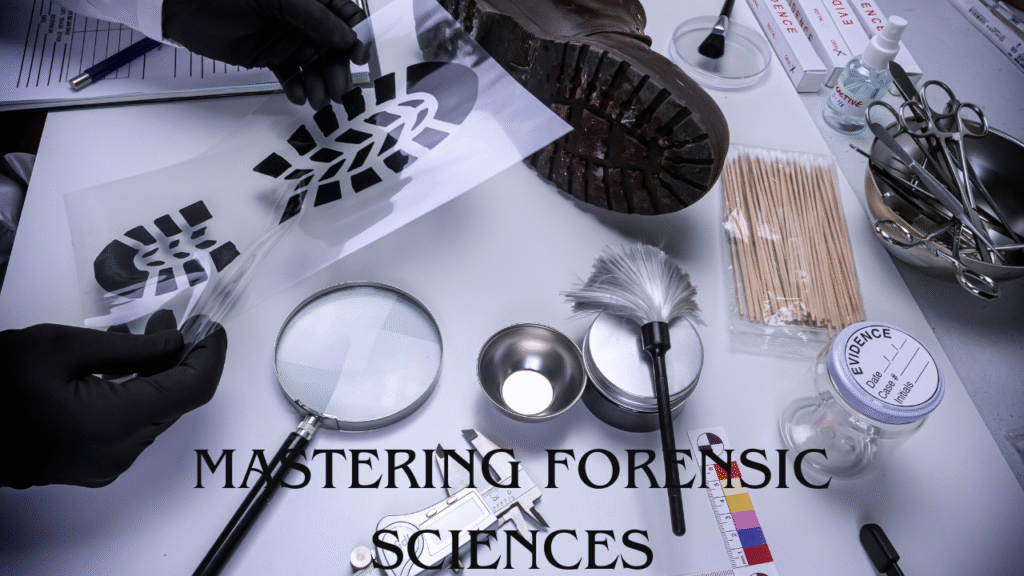
Forensic science is the application of scientific principles and methods to questions connected with criminal and civil investigations.
A forensic scientist may analyse physical, chemical, biological or digital evidence and interpret the results objectively.
The work can involve:
-
- examining biological samples;
-
- identifying chemical substances;
-
- analysing DNA;
-
- examining fibres, glass or other trace evidence;
-
- documenting crime scenes;
-
- analysing drugs and toxic substances;
-
- examining digital evidence;
-
- maintaining evidence integrity;
-
- preparing scientific reports;
-
- explaining findings in legal proceedings.
- explaining findings in legal proceedings.
The US Bureau of Labor Statistics describes forensic science technicians as professionals who collect and analyse evidence to support criminal investigations. Laboratory work can involve chemical, biological, microscopic and DNA analysis.
Accuracy is essential because forensic findings can become part of legal proceedings.
What Do You Study in Forensic Science?
A strong forensic science degree starts with science.
Students commonly encounter subjects such as:
-
- Chemistry
-
- Biology
-
- Molecular Biology
-
- Mathematics and Statistics
-
- Analytical Chemistry
-
- Biochemistry
-
- Forensic Biology
-
- Forensic Chemistry
-
- Crime Scene Investigation
-
- DNA Analysis
-
- Toxicology
-
- Trace Evidence
-
- Criminalistics
-
- Evidence Interpretation
-
- Law and Ethics
- Scientific Reporting
Penn State’s current Bachelor of Science in Forensic Science, for example, builds on biological, physical and mathematical sciences before covering areas such as forensic chemistry, molecular biology, criminalistics and crime-scene investigation.
Kent’s 2026 BSc similarly combines chemistry with DNA analysis, trace evidence, ballistics, simulated crime scenes and expert-witness training.
This scientific foundation is one reason students should not choose forensic science only because they enjoy crime documentaries or detective stories.
Popular Forensic Science Specialisations
Forensic Biology and DNA Analysis
Forensic biology applies biological science to evidence.
Students may study:
-
- DNA profiling;
-
- bodily fluids;
-
- biological trace evidence;
-
- genetics;
-
- molecular biology;
-
- microscopy.
- microscopy.
This pathway can suit students who enjoy biology, genetics and laboratory work.
Trent University, for example, offers a dedicated Forensic Biology undergraduate degree in addition to its general Forensic Science programme.
Forensic Chemistry and Toxicology
Forensic chemistry focuses on the chemical identification and analysis of substances.
Possible topics include:
-
- drugs;
-
- poisons;
-
- alcohol;
-
- explosives;
-
- fire debris;
-
- unknown substances;
-
- analytical instrumentation.
- analytical instrumentation.
Strathclyde’s MSc Forensic Science allows students to specialise in forensic chemistry or forensic biology. Its chemistry pathway includes fires and explosives, drugs, alcohol and toxicology.
Students interested in this area should build a strong chemistry background.
Crime Scene Investigation
Crime-scene investigation focuses on recognising, documenting, recovering and preserving evidence.
Training may involve:
-
- scene photography;
-
- evidence markers;
-
- fingerprints;
-
- biological evidence;
-
- scene documentation;
-
- evidence packaging;
-
- chain of custody.
- chain of custody.
Universities increasingly use simulated crime scenes so students can practise these skills before entering professional environments.
Kent uses a dedicated house and vehicles for simulated investigations, while Trent operates a specialist forensic crime-scene training facility.
Digital Forensics
Digital forensics deals with evidence stored on computers, phones and other electronic systems.
Students may encounter:
-
- computer crime;
-
- digital evidence recovery;
-
- mobile-device analysis;
-
- cyber investigations;
-
- data preservation.
- data preservation.
UTS offers digital forensic science as one of four specialisations within its Bachelor of Forensic Science alongside biology, chemistry and crime-scene investigation.
Students interested mainly in cybercrime should compare a forensic science degree with specialised cybersecurity or digital-forensics programmes before applying.
Forensic Anthropology
Forensic anthropology applies knowledge of the human skeleton and biological anthropology to legal investigations.
It can involve:
-
- human identification;
-
- skeletal analysis;
-
- recovery of human remains;
-
- trauma interpretation;
-
- mass-disaster investigations.
- mass-disaster investigations.
This is a specialised pathway. Advanced professional roles commonly require postgraduate study.
The University of Dundee, for example, offers postgraduate study specifically in Forensic Archaeology and Anthropology for students interested in the recovery and analysis of human remains.
Best Countries to Study Forensic Science Abroad
United Kingdom
The UK offers undergraduate, postgraduate and research programmes in forensic science and related specialisations.
Examples include:
-
- general forensic science;
-
- forensic chemistry;
-
- forensic biology;
-
- forensic anthropology;
-
- forensic archaeology;
-
- forensic dentistry.
- forensic dentistry.
The University of Kent offers a dedicated BSc with practical crime-scene and laboratory training, while the University of Strathclyde offers a 12-month MSc Forensic Science accredited by the Chartered Society of Forensic Sciences.
Consider the UK if you want: specialised postgraduate courses, practical training and relatively short Master’s programmes.
Canada
Canada offers both general forensic science degrees and science-focused specialisations.
Trent University currently provides undergraduate degrees in:
-
- Forensic Science;
-
- Forensic Biology;
-
- Forensic Chemistry;
-
- joint-major Forensic Science.
- joint-major Forensic Science.
It also offers an MSc in Forensic Science.
Trent’s undergraduate programme integrates science, law and investigative practice, including DNA applications and crime-scene investigation.
Consider Canada if you want: a multidisciplinary science degree combining laboratory work with legal and investigative training.
Australia
Australia provides specialised bachelor’s programmes with an emphasis on practical scientific skills.
The University of Technology Sydney offers a three-year Bachelor of Forensic Science with four specialist pathways:
-
- Biology;
-
- Chemistry;
-
- Crime Scene Investigation;
-
- Digital Forensic Science.
- Digital Forensic Science.
The programme currently offers both Autumn and Spring 2026 entry.
Consider Australia if you want: a specialised undergraduate degree with options spanning traditional laboratory science and digital evidence.
United States
The United States offers forensic science through universities as well as related majors in chemistry, biology and criminalistics.
Penn State’s 2026-27 Bachelor of Science in Forensic Science offers pathways in forensic chemistry and forensic molecular biology and requires substantial chemistry, mathematics and physics study.
The US also has a significant public-sector forensic laboratory system.
However, international students should investigate employment requirements carefully because some government, law-enforcement or security-related positions may have citizenship, residency, background-check or security-clearance requirements.
Consider the US if you want: a strong science foundation and access to specialised laboratory-based programmes.
Popular Universities Offering Forensic Science Courses
These institutions are examples, not a ranking.
| University | Country | Example Programme | Key Area |
|---|---|---|---|
| University of Kent | UK | BSc Forensic Science | DNA, trace evidence, ballistics, crime scenes |
| University of Strathclyde | UK | MSc Forensic Science | Forensic biology or chemistry |
| Trent University | Canada | BSc Forensic Science | Science, law, DNA and investigation |
| University of Technology Sydney | Australia | Bachelor of Forensic Science | Biology, chemistry, CSI, digital forensics |
| Penn State | USA | BS Forensic Science | Molecular biology and forensic chemistry |
Programme titles do not tell the full story.
Two universities offering Forensic Science may have very different laboratory facilities, specialisations and scientific depth.
Always compare the module list before applying.
Eligibility for Forensic Science Courses Abroad
Eligibility After Class 12
For bachelor’s-level Forensic Science Courses Abroad, universities generally expect completion of Class 12 or an equivalent secondary qualification.
Science subjects are particularly important.
Depending on the programme, preferred or required subjects may include:
-
- Chemistry;
-
- Biology;
-
- Mathematics;
-
- Physics.
- Physics.
Requirements vary significantly.
A chemistry-heavy programme may expect strong Chemistry preparation, while forensic biology can place greater emphasis on Biology.
International applicants may also need proof of English proficiency through an accepted test or another approved method.
Do not assume that every university accepts the same PCM, PCB or PCMB combination.
Eligibility for a Master’s Degree
Master’s programmes generally require a relevant undergraduate science degree.
Suitable backgrounds can include:
-
- Forensic Science;
-
- Chemistry;
-
- Biology;
-
- Biochemistry;
-
- Molecular Biology;
-
- Pharmacy;
-
- Biomedical Science;
-
- another relevant natural-science discipline.
Strathclyde’s MSc, for example, accepts relevant science backgrounds such as chemistry, biology, biochemistry, pharmacy, zoology and botany.
Trent’s MSc requires a four-year honours BSc or equivalent, relevant forensic experience or coursework and a minimum academic standard for admission consideration.
Applicants may additionally need:
-
- statement of purpose;
-
- CV;
-
- recommendation letters;
-
- transcripts;
-
- English-language evidence;
-
- research-writing sample for certain research pathways.
Forensic Science Course Duration
Typical programme lengths include:
| Programme | Common Duration |
|---|---|
| UK Bachelor’s | Around 3 years |
| US Bachelor’s | Around 4 years |
| Canadian Bachelor’s | Around 4 years |
| Australian Bachelor’s | Around 3 years |
| UK taught Master’s | Often 1 year |
| Canadian Master’s | Often 1–2 years |
| PhD | Commonly 3–5+ years |
For example, UTS lists its Bachelor of Forensic Science as three years full-time, while Strathclyde’s MSc is 12 months full-time.
Cost of Studying Forensic Science Abroad
The cost depends on the university, country and programme level. There is no single international forensic-science tuition fee.
For the UK, official Study UK guidance places general international undergraduate tuition broadly between £11,400 and £38,000 per year and postgraduate tuition between approximately £9,000 and £30,000, although individual specialist programmes can fall outside those ranges.
For Canada, 2026 government guidance reports average international university tuition of approximately CAD 41,746 per year for undergraduate students and CAD 24,028 for graduate students across fields. These are national averages rather than forensic-science-specific fees.
For Australia and the United States, tuition varies substantially by university and programme.
Students should calculate:
Total study cost = tuition + accommodation + food + health cover + transport + laboratory/course costs + visa expenses + personal expenses.
Always use the university’s official 2026 fee page for your final financial planning.
Forensic Science vs Criminology
These subjects are often confused.
| Forensic Science | Criminology |
|---|---|
| Science-based | Social-science based |
| Analyses physical or digital evidence | Studies crime and criminal behaviour |
| Strong laboratory component | Greater emphasis on society, psychology and policy |
| Chemistry and biology can be important | Sociology and criminal justice are common |
| Includes DNA, toxicology and trace evidence | Includes causes of crime and justice systems |
| Suitable for laboratory and evidence-focused careers | Suitable for policy, justice and social research careers |
If you enjoy chemistry, biology, laboratory investigation and objective evidence analysis, forensic science may be a better fit.
If your main interest is understanding why crime occurs and how justice systems respond, criminology may suit you better.
Career Opportunities After Forensic Science
Career possibilities depend strongly on your degree, specialisation and country.
Potential areas include:
-
- forensic laboratory analysis;
-
- forensic chemistry;
-
- forensic biology;
-
- DNA analysis;
-
- forensic toxicology;
-
- crime-scene investigation;
-
- trace-evidence analysis;
-
- digital forensics;
-
- quality assurance;
-
- scientific research;
-
- laboratory services;
-
- forensic consulting.
- forensic consulting.
Some specialist careers require additional postgraduate education, professional training or certification.
For example, forensic pathology requires medical training. Forensic dentistry requires dental qualifications, while advanced forensic anthropology commonly involves specialised postgraduate education.
Do not assume one general BSc qualifies you for every forensic career.
Can International Students Work as Forensic Scientists Abroad?
Potentially, but this needs realistic planning.
A forensic science degree obtained abroad does not automatically guarantee employment in that country’s government forensic laboratory or police system.
Some positions may require:
-
- citizenship;
-
- permanent residence;
-
- security clearance;
-
- criminal-background screening;
-
- professional certification;
-
- laboratory competency assessment;
-
- postgraduate qualifications.
- postgraduate qualifications.
Private laboratories, universities, scientific testing organisations and related industries may have different requirements.
Before selecting a country solely for employment, check actual job advertisements from forensic laboratories and government agencies.
This matters because the availability of university programmes and your eligibility to work in sensitive forensic positions are separate issues.
Skills You Need for a Career in Forensic Science
Successful forensic scientists need more than theoretical knowledge.
Focus on developing:
-
- laboratory accuracy and safety;
-
- analytical chemistry or molecular biology skills;
-
- evidence documentation;
-
- chain-of-custody procedures;
-
- statistics and data interpretation;
-
- scientific report writing;
-
- critical thinking;
-
- attention to detail;
-
- ethical decision-making;
-
- clear communication.
- clear communication.
Communication is particularly important.
Forensic professionals may need to explain complex scientific findings to investigators, lawyers or courts. The US Bureau of Labor Statistics specifically identifies analytical ability, communication, attention to detail, mathematics and problem-solving among important qualities for forensic science technicians.
Is Forensic Science a Good Career in 2026-27?
It can be a strong choice for students genuinely interested in science and evidence analysis.
In the United States, employment of forensic science technicians is currently projected to grow 13% between 2025 and 2035, faster than the overall occupational average. The median US annual wage was reported at $72,060 in May 2025.
These figures should not be treated as worldwide salary or employment expectations.
Career prospects differ by:
-
- country;
-
- public-sector recruitment;
-
- specialisation;
-
- qualification level;
-
- laboratory experience;
-
- immigration status.
- immigration status.
Students who build strong chemistry, biology, statistics, digital or analytical skills can also retain options outside narrowly defined forensic roles.
How to Choose the Right Forensic Science Programme
Look beyond the university name.
Check the Scientific Content
A strong programme should contain enough core science for your intended specialisation.
Examine Laboratory Facilities
Look for access to:
-
- analytical instruments;
-
- DNA laboratories;
-
- microscopy;
-
- simulated crime scenes;
-
- digital-forensics facilities.
Check Practical Experience
Prefer programmes offering:
-
- laboratory projects;
-
- crime-scene exercises;
-
- placements;
-
- internships;
-
- research projects.
Compare Specialisations
A student wanting digital forensics should not accidentally choose a degree focused almost entirely on wet-laboratory chemistry.
Look at Professional Recognition
Where relevant, check whether the course is recognised or accredited by an appropriate professional forensic-science body.
Investigate Graduate Requirements
Look at real job advertisements in your intended field and identify the degrees, skills and eligibility conditions employers request.
This prevents you from choosing a programme based only on its title.

How to Apply for Forensic Science Abroad
A practical application process is:
-
- Decide whether you want undergraduate or postgraduate study.
-
- Identify your preferred forensic specialisation.
-
- Shortlist countries and universities.
-
- Compare subject prerequisites.
-
- Check laboratory and practical-training facilities.
-
- Confirm English-language requirements.
-
- Prepare academic transcripts and certificates.
-
- Write your SOP or personal statement where required.
-
- Arrange recommendation letters for postgraduate applications.
-
- Submit applications before university deadlines.
-
- Compare offers, tuition and total living costs.
-
- Begin the appropriate student visa process after meeting the required admission conditions.
Receiving university admission and receiving a student visa are separate decisions.
Applicants must independently meet the immigration requirements of their chosen country.
Common Mistakes Students Should Avoid
One of the biggest mistakes is choosing forensic science because it looks exciting on television.
Real forensic work can involve repetitive laboratory procedures, documentation, quality control and careful interpretation rather than constant crime-scene investigation.
Students should also avoid:
-
- confusing forensic science with criminology;
-
- ignoring Chemistry and Biology requirements;
-
- choosing a programme without checking laboratories;
-
- assuming every forensic degree includes digital forensics;
-
- believing a degree guarantees a police or government job;
-
- overlooking citizenship or security requirements for sensitive positions;
-
- relying only on university rankings;
-
- assuming all forensic careers require the same qualification.
- assuming all forensic careers require the same qualification.
The best programme is the one that gives you the scientific foundation and specialist training required for the career you actually want.
Frequently Asked Questions
Can I study forensic science abroad after 12th?
Yes. Universities in countries including the UK, Canada, Australia and the United States offer undergraduate forensic science programmes. Academic and subject requirements vary between universities.
Which subjects are required for forensic science after Class 12?
Science subjects are usually important. Chemistry and Biology are particularly relevant, while Mathematics and Physics may also be required or recommended depending on the course.
Which country is best for forensic science?
The UK, Canada, Australia and the United States all offer strong programmes. The better choice depends on your specialisation, budget, academic profile and career goals rather than one universal ranking.
Is forensic science difficult?
It can be academically demanding because it combines laboratory science, statistics, evidence interpretation and legal procedures. Students comfortable with Chemistry, Biology and detailed scientific work may find it a good fit.
Is forensic science the same as criminology?
No. Forensic science uses scientific methods to analyse evidence. Criminology studies crime, criminal behaviour and the justice system from a social-science perspective.
Can I become a forensic scientist with a BSc?
A bachelor’s degree can qualify graduates for some entry-level laboratory or forensic roles, depending on the employer and country. More specialised positions may require postgraduate training.
Is forensic science a good career for Indian students abroad?
It can be, but students should investigate employment eligibility carefully. Some government or security-related forensic positions may have citizenship or residency restrictions, while private laboratories and research organisations may follow different rules.
Inference
Choosing Forensic Science Courses Abroad in 2026 can lead to specialised study in DNA analysis, forensic chemistry, toxicology, crime-scene investigation, digital forensics and other evidence-based disciplines.
The strongest programmes combine solid science with laboratory practice, evidence interpretation and an understanding of legal procedures.
Before applying, identify the forensic career you want first. Then compare course modules, laboratories, professional recognition, tuition costs and employment requirements. A carefully chosen science-based programme provides far better preparation than selecting a university simply because its course carries the forensic science title.
NOTE
This article is for educational and informational purposes. University admission requirements, tuition fees, visa rules, scholarships, immigration policies and post-study opportunities may change. Students should verify the latest information with the relevant university, government authority, immigration department, embassy or official source before making a decision.
Start Your Study Abroad Journey
If you are planning to study abroad and need help understanding your options, you can connect with a LetzStudy counsellor for personalised guidance. We can help you explore suitable countries, universities, courses, eligibility requirements, application steps and other aspects of your study-abroad journey based on your academic profile and goals.
Book a Free Consultation.
