


Automobile engineering is no longer limited to conventional engines, mechanical systems and vehicle manufacturing. The industry is increasingly connected with electric mobility, autonomous driving, advanced materials, embedded systems, vehicle software and intelligent transportation. For students interested in engineering and mobility, automobile engineering abroad can provide exposure to different technologies, research environments and automotive markets.
International universities offer automobile and automotive engineering through dedicated degrees as well as related fields such as mechanical engineering, vehicle engineering, mechatronics and mobility engineering. The right choice depends on your academic background, career interests, preferred country, budget and long-term goals.
This guide explains what you can study, where you can study it, admission requirements, approximate costs, career options and practical considerations for planning your 2026–27 study-abroad journey.
What Is Automobile Engineering?
Automobile engineering is an engineering discipline focused on the design, development, testing, manufacturing and operation of vehicles and their systems.
It combines principles from several areas, including:
-
- Mechanical engineering
-
- Electrical and electronics engineering
-
- Control engineering
-
- Materials engineering
-
- Computer science
-
- Manufacturing engineering
- Manufacturing engineering
Traditional topics such as engines, transmissions, vehicle dynamics and manufacturing remain relevant. At the same time, modern automobile engineering increasingly includes electric powertrains, battery systems, driver-assistance technologies, connected vehicles, simulation and autonomous mobility.
For example, the Automotive Engineering master’s programme at Technical University of Munich (TUM) brings together mechanical, electrical and software engineering and covers areas including electric vehicles, autonomous driving, production, materials, simulation and control systems.
This makes automobile engineering particularly suitable for students who want to work at the intersection of physical engineering and emerging mobility technologies.
Why Study Automobile Engineering Abroad?
Studying automobile engineering internationally can be valuable when the university and location align with your specific career goals.
Exposure to Advanced Automotive Technology
Different countries have strong ecosystems around vehicle manufacturing, electric mobility, motorsport, automotive research and intelligent transportation. Studying in such an environment can give students opportunities to learn about technologies being developed and tested within the industry.
Access to Specialised Programmes
Some universities offer dedicated automotive engineering degrees, while others provide specialisations through mechanical engineering, mechatronics or mobility programmes.
For instance, TUM’s Automotive Engineering M.Sc. includes specialisation opportunities involving electric vehicles, autonomous driving, production and materials, control engineering and mobility.
Industry-Oriented Learning
Automotive engineering is a practical field. Projects, laboratory work, simulations, internships and industry-linked assignments can help students connect theoretical concepts with engineering applications.
International Career Exposure
An overseas qualification can expose students to different automotive markets and professional environments. However, employment depends on factors such as academic performance, technical skills, work experience, language ability and applicable work-authorisation rules.
Opportunity to Build Interdisciplinary Skills
Modern vehicles combine mechanical components with sensors, software, electronics and control systems. Studying abroad can therefore be an opportunity to develop a broader engineering profile rather than focusing exclusively on traditional automotive systems.
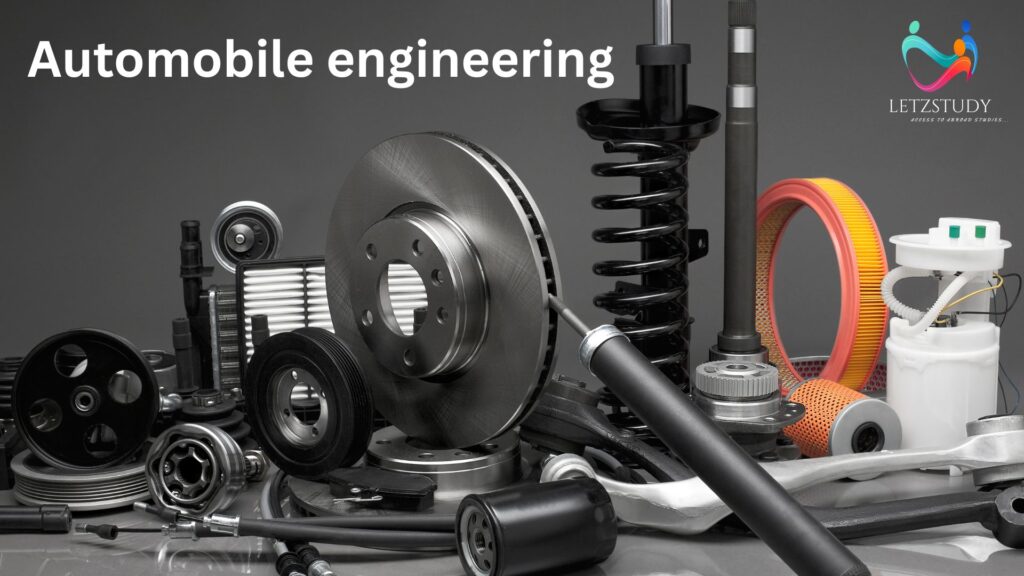
What Do You Study in an Automobile Engineering Degree?
The exact curriculum differs by university and qualification level. However, automobile engineering courses can cover several important areas.
Vehicle Design and Dynamics
Students may study how vehicles behave under different operating conditions.
Topics can include:
-
- Vehicle dynamics
-
- Chassis systems
-
- Suspension
-
- Steering
-
- Braking
-
- Vehicle aerodynamics
-
- Computer-aided design
-
- Engineering simulation
- Engineering simulation
These subjects help students understand how vehicle components interact and how engineering decisions affect performance, safety and efficiency.
Powertrain and Electric Vehicle Technology
Powertrain engineering traditionally includes engines, transmissions and related systems. Modern programmes increasingly address electrification.
Students may encounter subjects such as:
-
- Internal combustion engines
-
- Electric motors
-
- Hybrid powertrains
-
- Battery systems
-
- Power electronics
-
- Energy management
-
- Propulsion control
- Propulsion control
The balance between conventional and electric mobility depends on the programme.
Automotive Electronics and Control Systems
Modern vehicles rely heavily on electronic and digital systems.
Relevant areas may include:
-
- Sensors
-
- Electronic control units
-
- Embedded systems
-
- Control engineering
-
- Vehicle communication
-
- Driver-assistance systems
-
- Automotive software
- Automotive software
This is particularly useful for students interested in the convergence of automotive engineering and electronics.
Manufacturing and Production
Automobile engineering also involves understanding how vehicles and components are manufactured.
Courses can include:
-
- Manufacturing processes
-
- Production planning
-
- Quality engineering
-
- Automation
-
- Robotics
-
- Materials
-
- Industrial engineering
-
- Digital manufacturing
Autonomous and Connected Vehicles
Advanced programmes may explore technologies related to intelligent mobility, including autonomous driving, driver-assistance systems, connected vehicles and transportation systems.
These areas require knowledge that goes beyond traditional mechanical engineering, including control systems, computing, sensing and data-driven technologies.
Best Countries to Study Automobile Engineering Abroad
There is no single best destination for every student. Your ideal country should be selected based on programme content, university reputation, tuition and living expenses, language, industry exposure, admission requirements and career plans.
Germany
Germany is an important destination to consider for students interested in automotive and mobility engineering.
The country has a strong automotive manufacturing ecosystem, while German universities offer programmes spanning mechanical engineering, vehicle engineering, automotive engineering and related disciplines.
TUM’s M.Sc. in Automotive Engineering is a four-semester, 120-ECTS programme covering areas such as electric vehicles, production, materials, autonomous driving, control engineering and mobility.
International students should also examine the language requirements of each programme rather than assuming that every German automotive course is taught entirely in English.
Germany can also be attractive for students considering post-study employment. According to the official Make it in Germany portal, eligible international students can generally work up to 140 full days or 280 half-days per year during their studies, subject to the applicable rules. Graduates may also be able to obtain a residence permit for up to 18 months to look for qualified employment after completing their studies.
United Kingdom
The UK offers both undergraduate and postgraduate routes in automotive engineering.
For example, the University of Warwick offers a BEng in Automotive Engineering. Its programme includes engineering education specifically designed for careers in the automotive industry.
Cranfield University also offers an Automotive Engineering MSc, making the UK an option for students seeking postgraduate specialisation.
The UK can be particularly relevant for students who want an English-medium education and a relatively direct postgraduate pathway.
Eligible degree-level students on the UK Student route can generally work up to 20 hours per week during term time, subject to their visa conditions.
Canada
Canada can be considered by students interested in automotive engineering, mechanical engineering, manufacturing, mobility and related technologies.
Rather than searching only for programmes with “automobile engineering” in the title, students should also examine mechanical engineering programmes with automotive, manufacturing, mechatronics, vehicle or energy-related specialisations.
International students should carefully review current study-permit and work rules. Eligible students can generally work up to 24 hours per week off campus during academic sessions, with different provisions applying during scheduled breaks.
Canada’s rules for international students have changed in recent years, so students should verify the latest requirements before making application or financial decisions.
Australia
Australia offers engineering programmes across mechanical, mechatronics, manufacturing, electrical and related fields that can provide foundations for automotive and mobility careers.
Students should look beyond course titles and examine:
-
- Automotive subjects
-
- EV and energy systems content
-
- Robotics and automation
-
- Engineering design projects
-
- Industry placements
-
- Research opportunities
-
- Accreditation
- Accreditation
Australia may be particularly suitable for students who want to combine mechanical engineering with emerging technologies such as automation, electronics and sustainable transportation.
United States
The United States offers a wide range of engineering programmes, including mechanical engineering and specialised automotive or mobility pathways.
Students may find opportunities to study:
-
- Automotive systems
-
- Vehicle dynamics
-
- Electric vehicles
-
- Manufacturing
-
- Robotics
-
- Autonomous systems
-
- Automotive controls
-
- Materials
-
- Computational engineering
- Computational engineering
Because programme structures differ considerably between universities, students should compare the curriculum rather than selecting a university based only on its general reputation.
Automobile Engineering Courses Abroad
Students can choose from several academic pathways depending on their existing qualifications.
| Study Level | Common Pathways | Typical Focus |
|---|---|---|
| Bachelor’s | BEng/BTech or related engineering degree | Engineering fundamentals, vehicle systems, design and manufacturing |
| Master’s | MSc/MEng in Automotive, Vehicle or Mechanical Engineering | Advanced automotive systems, EVs, simulation, controls and research |
| Specialisation | Mechatronics, robotics, mobility, manufacturing or EV programmes | Specific technology areas within the automotive ecosystem |
| Doctoral | PhD in automotive or related engineering fields | Advanced research and innovation |
At the postgraduate level, automobile engineering may appear under different names. A student searching only for “automobile engineering” could therefore miss relevant programmes in mechanical engineering, vehicle engineering, mobility systems or mechatronics.
Eligibility to Study Automobile Engineering Abroad
Requirements vary by university and country, but students commonly need an academic background relevant to engineering.
For Bachelor’s Programmes
Applicants may typically need:
-
- Class 12 or equivalent qualification
-
- Mathematics and physics
-
- Chemistry or another relevant science subject where required
-
- Minimum academic grades specified by the university
-
- English-language proficiency where applicable
-
- Passport and supporting documents
- Passport and supporting documents
Some universities may have additional subject requirements or admissions procedures.
For Master’s Programmes
Applicants generally need:
-
- A recognised bachelor’s degree
-
- Relevant engineering or technical background
-
- Academic transcripts
-
- Required prerequisite subjects
-
- English-language proficiency where applicable
-
- Statement of purpose or motivation letter where required
-
- Curriculum vitae/resume
-
- Letters of recommendation where required
- Letters of recommendation where required
Requirements can be highly programme-specific. TUM, for example, assesses applicants to its Automotive Engineering master’s programme through an aptitude assessment and examines the academic content of the previous degree. Its current requirements also specify additional documentation and language evidence for international applicants.
Documents Required for Admission
The exact checklist depends on the university, but students should prepare documents such as:
-
- Academic transcripts
-
- Degree or school-leaving certificate
-
- Passport
-
- Curriculum vitae
-
- English-language test result where required
-
- Statement of purpose
-
- Letters of recommendation where required
-
- Portfolio or project evidence if requested
-
- Internship or work-experience documents where applicable
-
- Proof of financial resources for the relevant visa process where required
- Proof of financial resources for the relevant visa process where required
Do not assume that one document set will work for every university. Always compare the official programme requirements before submitting an application.
Cost of Studying Automobile Engineering Abroad
The total cost depends heavily on the country, university, qualification level, programme duration and lifestyle.
Major expenses can include:
-
- Tuition fees
-
- Accommodation
-
- Food
-
- Local transportation
-
- Health insurance
-
- Study materials
-
- Visa-related expenses
-
- Flights
-
- Personal expenses
- Personal expenses
For example, current university information shows substantial variation even within the same country. Warwick lists approximately £35,530 per year for its laboratory-based overseas undergraduate fee band for 2026–27, while Cranfield lists approximately £29,025 for its full-time overseas Automotive Engineering MSc for 2026–27.
TUM’s current Automotive Engineering M.Sc. page states that tuition fees for international students from non-EU countries are approximately €6,000 per semester, in addition to the applicable semester contribution.
These figures illustrate why students should calculate the full study budget rather than comparing tuition alone. Fees can change by academic year, university and student status.
For a realistic budget, consider tuition together with accommodation, food, transportation, insurance, visa requirements and travel.
Career Opportunities After Automobile Engineering
An automobile engineering qualification can lead to careers across traditional automotive companies as well as newer mobility and technology sectors.
Potential roles include:
-
- Automotive Design Engineer
-
- Vehicle Dynamics Engineer
-
- Automotive Manufacturing Engineer
-
- Powertrain Engineer
-
- EV Engineer
-
- Battery Systems Engineer
-
- Automotive Controls Engineer
-
- Vehicle Testing Engineer
-
- Automotive Simulation Engineer
-
- Production Engineer
-
- Quality Engineer
-
- Automotive Electronics Engineer
-
- Embedded Systems Engineer
-
- Mobility Systems Engineer
-
- Research and Development Engineer
- Research and Development Engineer
Career opportunities also extend beyond passenger vehicles. Automotive engineering skills can be relevant to commercial vehicles, motorsport, mobility technology, component manufacturing, transportation systems and engineering research.
However, a degree by itself does not guarantee employment. Practical experience, software skills, projects, internships, communication ability and knowledge of the local employment market can significantly influence career prospects.
Skills That Can Improve Your Automotive Engineering Career
Students can strengthen their profile by developing a combination of engineering fundamentals and digital skills.
Technical Skills
Depending on your specialisation, useful skills may include:
-
- CAD
-
- CAE
-
- MATLAB/Simulink
-
- Finite element analysis
-
- Computational fluid dynamics
-
- Vehicle simulation
-
- Control systems
-
- Embedded systems
-
- Programming
-
- Battery and EV technologies
Practical Skills
Try to gain experience through:
-
- University projects
-
- Automotive competitions
-
- Engineering clubs
-
- Research projects
-
- Internships
-
- Laboratory work
-
- Industry projects
Soft Skills
Automotive engineering is collaborative. Communication, teamwork, problem-solving, documentation and project management can therefore be valuable alongside technical knowledge.
How to Choose the Right Automobile Engineering University
Instead of choosing a university solely because it appears in a ranking, evaluate it against your personal goals.
Consider these questions:
-
- Does the curriculum match your interests?
Check whether the programme focuses on EVs, vehicle dynamics, manufacturing, autonomous systems, electronics or another area you want to pursue.
- Does the curriculum match your interests?
-
- Is the programme suitable for your academic level?
A bachelor’s applicant and a mechanical engineering graduate looking for a master’s will need very different programmes.
- Is the programme suitable for your academic level?
-
- What practical experience is available?
Look for laboratories, projects, internships, industry collaborations and research opportunities.
- What practical experience is available?
-
- What language is required?
Check whether the programme is taught in English, German or another language.
- What language is required?
-
- What is the complete cost?
Consider tuition and living expenses together.
- What is the complete cost?
-
- What are the admission requirements?
Check prerequisites, academic grades, language tests and programme-specific requirements.
- What are the admission requirements?
-
- What are the local work rules?
Student work rights and post-study pathways can change. Review the current government requirements for your destination.
- What are the local work rules?
-
- Does the university’s location fit your career plans?
A university located near an automotive or mobility cluster may provide useful opportunities, but location alone should not determine your choice.
- Does the university’s location fit your career plans?
Application Process for Automobile Engineering Abroad
A structured application plan can help prevent missed requirements.
Step 1: Identify Your Specialisation
Decide whether you are most interested in:
-
- Traditional automotive engineering
-
- Electric vehicles
-
- Battery technology
-
- Automotive electronics
-
- Autonomous vehicles
-
- Vehicle dynamics
-
- Manufacturing
-
- Automotive software
-
- Mobility systems
Step 2: Shortlist Universities
Compare universities based on programme content, eligibility, costs, location, language and career opportunities.
Step 3: Check Entry Requirements
Read the official programme page carefully and confirm:
-
- Academic prerequisites
-
- Required subjects
-
- Minimum grades
-
- Language requirements
-
- Entrance tests, if applicable
-
- Application deadlines
Step 4: Prepare Your Documents
Arrange transcripts, certificates, test scores, recommendation letters, statements and other required documents well before the deadline.
Step 5: Submit Applications
Apply through the university’s official application system or the designated application platform required by the destination.
Step 6: Plan Your Student Visa
After receiving an appropriate admission offer, review the applicable student visa or study-permit requirements.
Admission to a university and approval of a student visa are separate processes. Meeting university requirements does not guarantee visa approval.
Step 7: Prepare for Your Move
Once the required approvals are in place, plan accommodation, insurance, travel, finances and other pre-departure arrangements.
Common Mistakes Students Should Avoid
Choosing a University Only by Ranking
A highly ranked university may not have the exact automotive specialisation you want. Curriculum fit should be one of your primary considerations.
Searching Only for “Automobile Engineering”
Some strong programmes are titled Automotive Engineering, Vehicle Engineering, Mechanical Engineering, Mobility Engineering or Mechatronics.
Ignoring Emerging Technologies
Automotive engineering is evolving rapidly. Students should consider how EVs, software, electronics, automation and autonomous systems fit into their intended career.
Focusing Only on Tuition Fees
A lower tuition fee does not necessarily mean a lower total cost. Accommodation and everyday expenses can make a significant difference.
Applying Without Checking Prerequisites
A programme may require specific mathematics, engineering or programming knowledge. Always review the official entry requirements.
Treating Student Work as the Main Funding Strategy
Part-time work can be subject to visa conditions and hour limits. It should not be treated as a substitute for having sufficient funds to support your studies.
Waiting Until the Last Minute
International applications can involve document preparation, language tests, financial planning and visa procedures. Starting early gives you more time to address unexpected requirements.
FAQs
Is automobile engineering a good career choice for students?
Automobile engineering can be a strong option for students interested in vehicles, engineering design and mobility technology. The field is expanding into EVs, electronics, automation, software and intelligent transportation.
Can I study automobile engineering abroad after Class 12?
Yes. Students can apply for bachelor’s-level engineering programmes abroad if they meet the academic and language requirements of the chosen university. Requirements vary by country and institution.
Can mechanical engineering students pursue automotive engineering abroad?
Yes. Mechanical engineering is a common academic foundation for postgraduate automotive engineering programmes. However, individual universities may require specific prerequisite subjects.
Which country is best for automobile engineering abroad?
There is no universally best country. Germany, the UK, Canada, Australia and the US can all be considered, depending on your preferred specialisation, budget, language, university choices and career plans.
Is automotive engineering only about petrol and diesel vehicles?
No. Modern automotive engineering also covers electric and hybrid vehicles, batteries, electronics, control systems, autonomous driving, connected vehicles, manufacturing and mobility systems.
What skills should I learn before studying automotive engineering?
A strong foundation in mathematics, physics and engineering fundamentals is useful. Depending on your programme, CAD, programming, simulation, electronics and control-system knowledge can also help.
Can I work while studying automobile engineering abroad?
Work rights depend on the country, visa type and student status. For example, eligible students in Germany can generally work within specified annual limits, while eligible UK degree-level students can generally work up to 20 hours per week during term time. Canada currently allows eligible students to work up to 24 hours per week off campus during academic sessions.
Students should always verify the rules applicable to their own visa before accepting employment.
Key Takeaways
Automobile engineering abroad can be a valuable pathway for students who want to build careers around vehicle technology, electric mobility, manufacturing, electronics, autonomous systems or intelligent transportation. The strongest choice is not simply the country with the biggest automotive industry, but the programme that matches your academic background, technical interests, budget and career goals.
Before applying, compare curriculum, eligibility, university requirements, total study costs, practical opportunities and current immigration rules. Starting your research early can also give you more time to prepare language tests, documents and applications.
For students planning for 2026–27, the most important step is to look beyond the traditional idea of automobile engineering and consider how the field is evolving toward electric, connected, autonomous and software-driven mobility.
Start Your Study Abroad Journey
If you are planning to study abroad and need help understanding your options, you can connect with a LetzStudy counsellor for personalised guidance. We can help you explore suitable countries, universities, courses, eligibility requirements, application steps and other aspects of your study-abroad journey based on your academic profile and goals.
Book a Free Consultation
