


Culinary Arts takes you to a place where discipline and creativity meet. It’s more than just recipes. It’s about knowing how to cook, how to taste, and the art behind each dish. Once you start thinking of the kitchen as a place where ideas become experiences, the whole field opens up. This guide gives you the skills, the mindset, and the foundations you need to make real progress. Let’s break it down so you can get better and faster without feeling like you have too much to do.
What the term “culinary arts” really means
The study and practice of cooking, preparing food, and running a kitchen is called culinary arts. This really means learning how food works, why techniques are important, and how professionals make sure that flavour and presentation are always the same.
Why the Culinary Arts Are Important Today
People care more about food than ever, and the industry is always changing. Knowing the basics will help you move with confidence, whether you’re cooking at home or planning a career.
The Most Important Parts of Culinary Arts
These pillars affect how chefs think, act, and get better in the kitchen.
Method
The backbone is technique. Everything gets easier once you know how to handle heat, timing, and knives.
Putting things in order
A clean, organised workspace cuts down on mistakes and saves time.
Taste
Making sure that taste, texture, and smell are all in balance makes average dishes stand out.
Stability
Professionals don’t rely on luck. They use methods that make sure the same results happen every time.
Skills That Every Culinary Arts Student Needs to Learn
These skills are like the tools you need to get started.
How to Use a Knife
Knife control makes you faster and more accurate. It also makes cooking safer. Instead of speed, focus on making cuts that are smooth and sure.
Control of Heat
To cook well, you need to know how heat works. Each one makes a different result: low and slow, fast and hot, steady and moderate.
Adding flavour
Salt isn’t just for making food taste salty. It’s all about bringing out the natural flavours. The same goes for acids and herbs.
Pairing Flavours
When you know which ingredients go well together, making new dishes becomes second nature.
When
Like a dance, professional kitchens work. You might not think that your ability to sync processes is very important.
Important Cooking Skills to Learn
A lot of people know about these techniques, but not many really understand them.
Methods of Dry Heat
By browning or crisping food, dry heat brings out strong flavours.
Sautéing
Cooking quickly over high heat with a little bit of fat.
Roasting
Slow change that makes the taste more complex.
Grilling
A lot of heat that makes smoky, burnt notes.
Methods of Moist Heat
These methods make textures softer and flavours milder.
Boiling
It’s easy to miss, though. Everything depends on timing.
Steaming
Keeps flavours clean and nutrients intact.
Braising
Cuts tough pieces of meat and makes sauces that are deep and rich.
Starting Your Culinary Arts Education at Home
You don’t need a kitchen for business. You need to have a goal.
Start with the main recipes
Choose meals that teach ideas instead of steps.
For example, roast chicken
You learn how to control the heat, add spices, and check for doneness.
Risotto is an example
Teaches how to be patient and control texture.
Practice for a Reason
Make the same dish a few times. Pay attention to what changes. This is how chefs get a gut feeling.
Get your work area in order
Put everything out before you start cooking. It helps you think clearly and makes fewer mistakes.
Developing Flavour in Cooking
This is where you should put your focus if you want your food to stand out.
Add layers of taste
Put in the right amount of ingredients at the right time.
First, add the aromatics
Put onions, garlic, ginger, or spices in the pan first.
Later on, liquids
Broths, wine, or cream make the body stronger.
At the end, add acids and fresh herbs
They make everything brighter.
Learn about the Flavour Triangle
Get the right amount of salt, fat, and acid. If a dish tastes flat, one of these three things usually needs to be changed.
Different Career Paths in the Culinary Arts
You have more options than just being a chef if you want to work in the industry.
Kitchens for Professionals
Hotels, restaurants, catering companies, and resorts.
Cook in Line
The place where you learn speed and discipline.
Sous Chef
The second-in-command makes sure everything runs smoothly.
Head Chef
The creative lead is in charge of the whole kitchen.
Starting a food business
Food trucks, bakeries, meal services, and pop-ups.
Food Media
Making recipes, writing content, taking pictures of food, and making cookbooks.
Science of Food
Quality control, product innovation, and research labs.
How to Take Your Cooking Skills to the Next Level
Repetition, curiosity, and small challenges all help you get better.
Teach Your Taste Buds
Try a lot of different foods. Look at different versions of the same dish. Pay attention to small changes.
Look at the Menus
Menus from professionals show you how to mix flavours and what’s popular right now.
Write Down What You Cook
Write down what worked and what didn’t. Even little changes are important.
Learn from your mistakes
It’s not a failure if a pan burns or a dish isn’t seasoned enough. It’s just information.
Things That Help the Culinary Arts Grow
You don’t need a lot of tools. You need things that will really help you cook better.
Knives That Feel Good
Choose one chef’s knife and get to know it well.
Cutting Boards That Keep Your Blades Safe
Wood or heavy-duty plastic is best.
Pans That Heat Up Evenly
When you cook with stainless steel and cast iron, you can be sure of what you’re doing.
Thermometers
Don’t guess when it’s done.
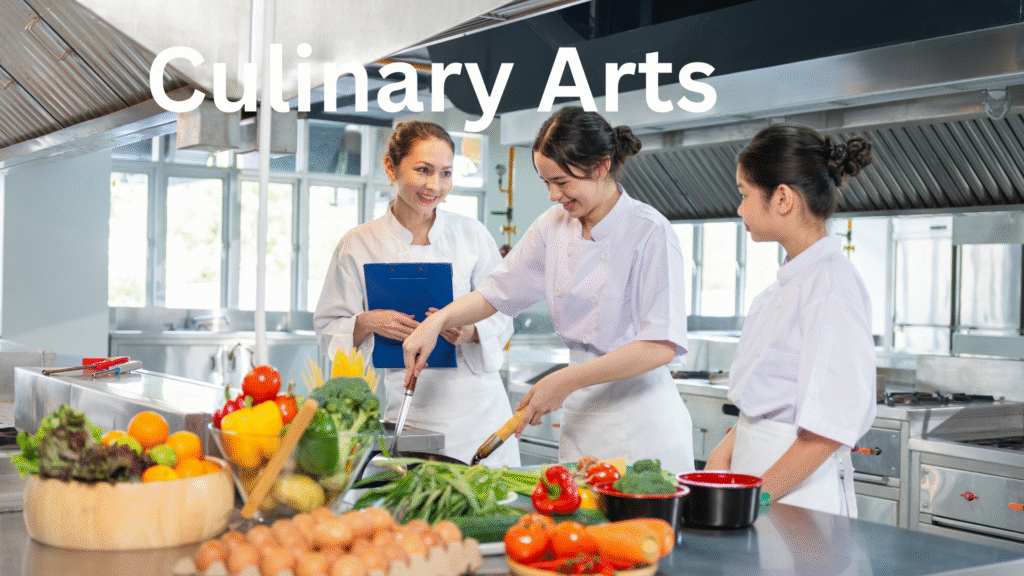
The Mindset Behind Mastering the Culinary Arts
Half of the equation is skill. The way you think affects how far you go.
Stay Interested
Try out ingredients that you haven’t used before.
Be patient
It takes time, but you will get better at it.
Stay the Same
Make food often. Small steps add up faster than big jumps.
What are the Culinary Arts?
Here’s the deal: cooking is more than just following recipes. It’s the art of making food that tastes good, is good for you, is cheap, is safe, and is fun to eat. That means knowing how to use a knife, control heat, design a menu, keep food safe, manage people, know how to work with the supply chain, and tell stories—all of which will help your kitchen run smoothly and make sure your customers leave feeling the way you want them to.
Below, I’ll show you a short, useful guide for six common reasons why cooking goes wrong, 13 management tips you can use right away, where to find more experts and influencers, how to test and reason with other people’s points of view, the most important stats to keep an eye on, and a brief real-world case study that you can learn from.
Six common reasons why people have problems with cooking and the honest way to fix them
- Not enough consistency (technique not standardised) → Fix: standard recipes, temperature logs, and daily tastings.
- Weak food safety culture? Fix it with short, regular training and visible critical control checks. (FoodManufacture.co.uk)
- Staff turnover and unclear roles → Solution: cross-training, clear career paths, and predictable schedules. (Auguste Escoffier Global Solutions)
- Menu bloat and wrong pricing? Fix it by making the menu better and getting rid of items that don’t make much money but waste a lot of food. (ResearchGate)
- Problems with supply (cost increases, shortages) → Solution: get more suppliers and make seasonal menus.
- Ignoring guest feedback (slow iteration) → Solution: keep an eye on KPIs and hold weekly problem-solving sessions.
13 useful tips for managing culinary arts
- Before the shift, hold a 10-minute meeting to talk about today’s risks, specials, and allergies.
- Have three “anchor” dishes that every line member can make perfectly.
- Keep track of temperatures and waste digitally and go over them together every morning.
- Use menu engineering to find stars, plowhorses, puzzles, and dogs. (ResearchGate)
- Short, repeated micro-trainings are better than long, once-a-month lectures.
- Make a 7-day rolling prep plan that is based on demand forecasts.
- Make sure there is only one source of truth for recipes (no guessing).
- Do audits and price negotiations with suppliers every three months.
- Give bonuses and recognition for quality, not just speed.
- Every month, do a “mystery meal” internal audit, which is a blind taste test to see if everything is the same.
- Use simple tech, like a dashboard for guest feedback and real-time inventory. (Connect Raj)
- Plan for backup: two people know how to use each important station.
- Make sure your staff is healthy by giving them regular hours, water, and breaks.
Where to find other experts and people who have a lot of followers
If you want to know what’s working right now, follow a mix:
Influencers
Influencers who are also chefs on Instagram and TikTok who show how to do things (not just how to plate food), like timing, mise en place, and ways to cut down on waste. Curated rankings on industry lists are some of the best chef/influencer lists . (FeedSpot for Influencers)
Industry Reports
For real numbers, look at industry reports and groups like the National Restaurant Association and state-level hospitality reports. (visit.restaurant.org)
Academic and Product Case Studies
Papers on menu engineering and operations systems. (ResearchGate)
Why it matters
Influencers show you new ways to do things and new trends, while industry reports show you what you need to do to be successful.
How to talk to other experts and see if their point of view is right
- Request the claim, the proof, and the edge cases.
- Change stories into testable hypotheses: “This cuts down on waste” → measure waste before and after for 30 days.
- Run small tests (A/B): one shift uses technique A and another shift uses technique B. Keep track of time, waste, and guest score.
- Look for data that disagrees: if everyone praises a method, ask who it didn’t work for and why.
- Don’t just fix the symptoms; use root-cause analysis (5 Whys) after a failure.
Numbers to remember
- The size of the global foodservice market will be about $4 trillion (order of magnitude). Use this to compare the growth of different segments and their willingness to invest.
- Public health: Every year, about 1 in 10 people around the world get sick from eating contaminated food. Food safety is a major risk, not a minor one.
- Hiring trend: The sector is adding jobs and is expected to grow in the long term, but the recovery is not happening evenly. Plan for uneven labour availability in different areas.
Short, easy-to-steal case study: a kitchen that fixed consistency and cut down on waste
A mid-sized urban restaurant had trouble with inconsistent entrees, long wait times, and rising food costs.
What was done
- Put all the standardised recipes into one digital recipe book.
- Set up a 7-day prep plan and a 10-minute daily taste-and-safety meeting.
- Made changes to the menu to get rid of two items with low margins and add one special with high margins and low waste.
Results after 30 days
Better plate consistency, 8% lower food costs, and guest ratings up by one-third on speed and accuracy. The method is similar to research on productized restaurant management systems and menu engineering. (Connect Raj)
Making your Culinary Arts management content useful for your team
- Keep it small: turn theory into training videos that last 1–3 minutes at each station.
- Write checklists instead of essays, one page for each role.
- Only keep an eye on three KPIs: the plate consistency score, the food cost percentage, and the staff turnover rate.
- Have weekly syncs that focus on problems (what went wrong, why, and how to fix it).
- Be open about your wins—small public awards are better than big monthly ones.
Expert-Level Books and Quotes
Three important books and articles about the culinary arts
- Le Guide Culinaire by Auguste Escoffier is a classic book that set the standards for French haute cuisine and modern professional kitchen practices.
- Ma Gastronomie by Fernand Point: A collection of classic thoughts and recipes from one of the most important chefs of the 20th century that capture the essence, philosophy, and art of French cooking.
- The French Laundry Cookbook by Thomas Keller (with Michael Ruhlman and Susie Heller) is a modern classic that combines technical accuracy, philosophical depth, and high-level cooking skills for both chefs and serious cooks.
Two quotes from experts about the culinary arts
- “Cooking isn’t about making things easier or taking shortcuts.” We can’t enjoy cooking anymore because we want quick, easy meals that only take 20 minutes to make and come with prewashed, pre-cut ingredients. Don’t rush. Take your time. “Take your time and pay close attention.” — Thomas Keller (Lib Quotes)
- Thomas Keller said, “When you realise that there is no such thing as perfect food, only the idea of it, then the real purpose of striving towards perfection becomes clear: to make people happy, that is what cooking is all about.”

How LetzStudy Helped Three Students
1. Darshan from Shivamogga
He loved cooking at home, but he didn’t know how to make it a job. LetzStudy helped him find the best cooking schools for him, explained the steps to getting in, and got him ready for his interviews. He came in nervous and left with an acceptance letter to a programme that was perfect for him.
2. Meghana lives in Udupi
She had always wanted to learn how to make pastries, but she was overwhelmed by all the course options available abroad. LetzStudy broke things down, put programmes next to each other, and helped her pick a path that was good for her in terms of cost, skill growth, and long-term chances. She is now learning how to make pastries and loves every minute of it.
3. Sanjay from Ballari
He wanted a strong base in cooking, but he didn’t know how to choose between schools or training labs. LetzStudy planned out the whole process for him, helped him improve his portfolio, and made the application process easy for him. He’s now in a hands-on programme that pushes him in all the right ways.
Contact LetzStudy and set up a consultation if you want help planning your Culinary Arts journey.
For more information, connect us on LinkedIn, and for daily updates, follow us on Instagram.
Universities regularly update their fees, eligibility, and policies. While we aim to keep this content accurate, readers should always check official sources for the latest information.
